


Page 117 - Python Data Science Handbook
P. 117
The Pandas Series Object

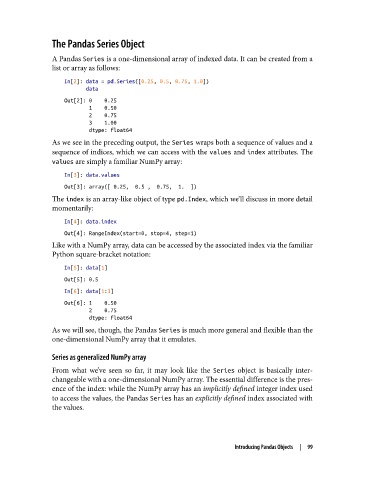
               A Pandas Series is a one-dimensional array of indexed data. It can be created from a
               list or array as follows:

                   In[2]: data = pd.Series([0.25, 0.5, 0.75, 1.0])
                          data
                   Out[2]: 0    0.25
                           1    0.50
                           2    0.75
                           3    1.00
                           dtype: float64
               As we see in the preceding output, the Series wraps both a sequence of values and a
               sequence of indices, which we can access with the values and index attributes. The
               values are simply a familiar NumPy array:

                   In[3]: data.values
                   Out[3]: array([ 0.25,  0.5 ,  0.75,  1.  ])
               The index is an array-like object of type pd.Index, which we’ll discuss in more detail
               momentarily:

                   In[4]: data.index
                   Out[4]: RangeIndex(start=0, stop=4, step=1)
               Like with a NumPy array, data can be accessed by the associated index via the familiar
               Python square-bracket notation:

                   In[5]: data[1]
                   Out[5]: 0.5
                   In[6]: data[1:3]
                   Out[6]: 1    0.50
                           2    0.75
                           dtype: float64
               As we will see, though, the Pandas Series is much more general and flexible than the
               one-dimensional NumPy array that it emulates.

               Series as generalized NumPy array
               From what we’ve seen so far, it may look like the Series  object is basically inter‐
               changeable with a one-dimensional NumPy array. The essential difference is the pres‐
               ence of the index: while the NumPy array has an implicitly defined integer index used
               to access the values, the Pandas Series has an explicitly defined index associated with
               the values.


                                                                  Introducing Pandas Objects  |  99

