


Page 137 - Python Data Science Handbook
P. 137
According to NumPy’s broadcasting rules (see “Computation on Arrays: Broadcast‐
               ing” on page 63), subtraction between a two-dimensional array and one of its rows is
               applied row-wise.
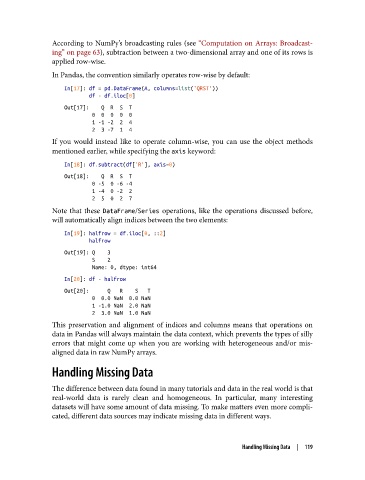
               In Pandas, the convention similarly operates row-wise by default:

                   In[17]: df = pd.DataFrame(A, columns=list('QRST'))
                           df - df.iloc[0]
                   Out[17]:    Q  R  S  T
                            0  0  0  0  0
                            1 -1 -2  2  4
                            2  3 -7  1  4
               If you would instead like to operate column-wise, you can use the object methods
               mentioned earlier, while specifying the axis keyword:

                   In[18]: df.subtract(df['R'], axis=0)
                   Out[18]:    Q  R  S  T
                            0 -5  0 -6 -4
                            1 -4  0 -2  2
                            2  5  0  2  7
               Note that these DataFrame/Series  operations, like the operations discussed before,
               will automatically align indices between the two elements:

                   In[19]: halfrow = df.iloc[0, ::2]
                           halfrow
                   Out[19]: Q    3
                            S    2
                            Name: 0, dtype: int64
                   In[20]: df - halfrow
                   Out[20]:      Q   R    S   T
                            0  0.0 NaN  0.0 NaN
                            1 -1.0 NaN  2.0 NaN
                            2  3.0 NaN  1.0 NaN
               This preservation and alignment of indices and columns means that operations on
               data in Pandas will always maintain the data context, which prevents the types of silly
               errors that might come up when you are working with heterogeneous and/or mis‐
               aligned data in raw NumPy arrays.

               Handling Missing Data

               The difference between data found in many tutorials and data in the real world is that
               real-world data is rarely clean and homogeneous. In particular, many interesting
               datasets will have some amount of data missing. To make matters even more compli‐
               cated, different data sources may indicate missing data in different ways.


                                                                    Handling Missing Data  |  119

