


Page 136 - Python Data Science Handbook
P. 136
Notice that indices are aligned correctly irrespective of their order in the two objects,
               and indices in the result are sorted. As was the case with Series, we can use the asso‐
               ciated object’s arithmetic method and pass any desired fill_value to be used in place
               of missing entries. Here we’ll fill with the mean of all values in A (which we compute
               by first stacking the rows of A):

                   In[14]: fill = A.stack().mean()
                           A.add(B, fill_value=fill)
                   Out[14]:       A     B     C
                            0   1.0  15.0  13.5
                            1  13.0   6.0   4.5
                            2   6.5  13.5  10.5
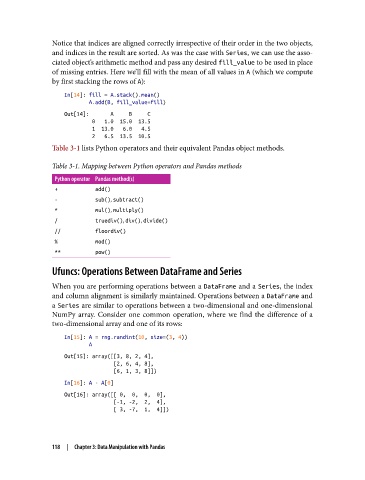
               Table 3-1 lists Python operators and their equivalent Pandas object methods.

               Table 3-1. Mapping between Python operators and Pandas methods
                Python operator Pandas method(s)
                +          add()
                -          sub(), subtract()
                *          mul(), multiply()
                /          truediv(), div(), divide()
                //         floordiv()
                %          mod()
                **         pow()

               Ufuncs: Operations Between DataFrame and Series
               When you are performing operations between a DataFrame and a Series, the index
               and column alignment is similarly maintained. Operations between a DataFrame and
               a Series are similar to operations between a two-dimensional and one-dimensional
               NumPy array. Consider one common operation, where we find the difference of a
               two-dimensional array and one of its rows:

                   In[15]: A = rng.randint(10, size=(3, 4))
                           A
                   Out[15]: array([[3, 8, 2, 4],
                                   [2, 6, 4, 8],
                                   [6, 1, 3, 8]])
                   In[16]: A - A[0]
                   Out[16]: array([[ 0,  0,  0,  0],
                                   [-1, -2,  2,  4],
                                   [ 3, -7,  1,  4]])


               118  |  Chapter 3: Data Manipulation with Pandas

