


Page 139 - Python Data Science Handbook
P. 139
likely even requiring a new fork of the NumPy package. Further, for the smaller data
               types (such as 8-bit integers), sacrificing a bit to use as a mask will significantly
               reduce the range of values it can represent.
               NumPy does have support for masked arrays—that is, arrays that have a separate
               Boolean mask array attached for marking data as “good” or “bad.” Pandas could have
               derived from this, but the overhead in both storage, computation, and code mainte‐
               nance makes that an unattractive choice.
               With these constraints in mind, Pandas chose to use sentinels for missing data, and
               further chose to use two already-existing Python null values: the special floating-
               point NaN value, and the Python None object. This choice has some side effects, as we
               will see, but in practice ends up being a good compromise in most cases of interest.

               None: Pythonic missing data
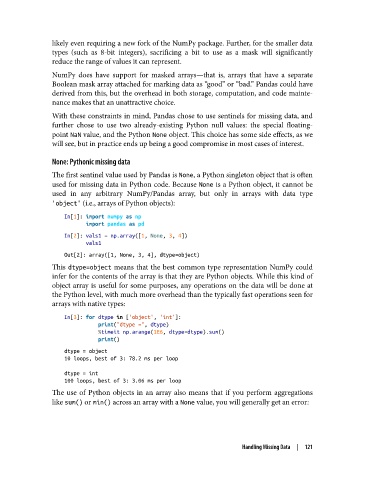
               The first sentinel value used by Pandas is None, a Python singleton object that is often
               used for missing data in Python code. Because None is a Python object, it cannot be
               used in any arbitrary NumPy/Pandas array, but only in arrays with data type
               'object' (i.e., arrays of Python objects):

                   In[1]: import numpy as np
                          import pandas as pd
                   In[2]: vals1 = np.array([1, None, 3, 4])
                          vals1
                   Out[2]: array([1, None, 3, 4], dtype=object)
               This dtype=object  means that the best common type representation NumPy could
               infer for the contents of the array is that they are Python objects. While this kind of
               object array is useful for some purposes, any operations on the data will be done at
               the Python level, with much more overhead than the typically fast operations seen for
               arrays with native types:

                   In[3]: for dtype in ['object', 'int']:
                              print("dtype =", dtype)
                              %timeit np.arange(1E6, dtype=dtype).sum()
                              print()
                   dtype = object
                   10 loops, best of 3: 78.2 ms per loop

                   dtype = int
                   100 loops, best of 3: 3.06 ms per loop
               The use of Python objects in an array also means that if you perform aggregations
               like sum() or min() across an array with a None value, you will generally get an error:


                                                                    Handling Missing Data  |  121

