


Page 152 - Python Data Science Handbook
P. 152
Out[19]: subject      Bob       Guido         Sue
                            type          HR  Temp    HR  Temp    HR  Temp
                            year visit
                            2013 1      31.0  38.7  32.0  36.7  35.0  37.2
                                 2      44.0  37.7  50.0  35.0  29.0  36.7
                            2014 1      30.0  37.4  39.0  37.8  61.0  36.9
                                 2      47.0  37.8  48.0  37.3  51.0  36.5
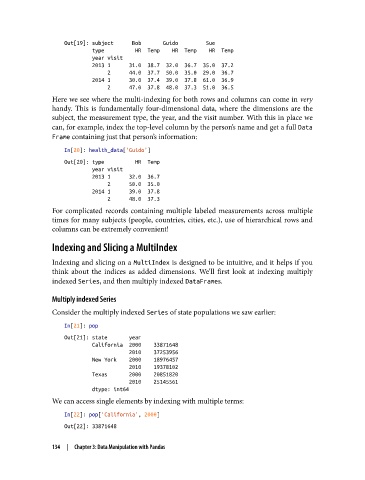
               Here we see where the multi-indexing for both rows and columns can come in very
               handy. This is fundamentally four-dimensional data, where the dimensions are the
               subject, the measurement type, the year, and the visit number. With this in place we
               can, for example, index the top-level column by the person’s name and get a full Data
               Frame containing just that person’s information:
                   In[20]: health_data['Guido']
                   Out[20]: type          HR  Temp
                            year visit
                            2013 1      32.0  36.7
                                 2      50.0  35.0
                            2014 1      39.0  37.8
                                 2      48.0  37.3
               For complicated records containing multiple labeled measurements across multiple
               times for many subjects (people, countries, cities, etc.), use of hierarchical rows and
               columns can be extremely convenient!

               Indexing and Slicing a MultiIndex

               Indexing and slicing on a MultiIndex is designed to be intuitive, and it helps if you
               think about the indices as added dimensions. We’ll first look at indexing multiply
               indexed Series, and then multiply indexed DataFrames.

               Multiply indexed Series
               Consider the multiply indexed Series of state populations we saw earlier:

                   In[21]: pop
                   Out[21]: state       year
                            California  2000    33871648
                                        2010    37253956
                            New York    2000    18976457
                                        2010    19378102
                            Texas       2000    20851820
                                        2010    25145561
                            dtype: int64
               We can access single elements by indexing with multiple terms:

                   In[22]: pop['California', 2000]
                   Out[22]: 33871648

               134  |  Chapter 3: Data Manipulation with Pandas

