


Page 156 - Python Data Science Handbook
P. 156
2      0.569264
                            b     1      0.001693
                                  2      0.526226
                            dtype: float64
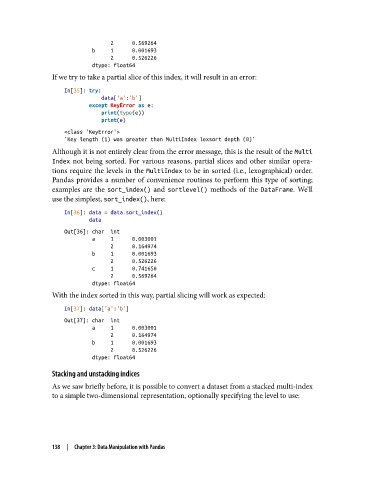
               If we try to take a partial slice of this index, it will result in an error:

                   In[35]: try:
                               data['a':'b']
                           except KeyError as e:
                               print(type(e))
                               print(e)
                   <class 'KeyError'>
                   'Key length (1) was greater than MultiIndex lexsort depth (0)'

               Although it is not entirely clear from the error message, this is the result of the Multi
               Index  not being sorted. For various reasons, partial slices and other similar opera‐
               tions require the levels in the MultiIndex  to be in sorted (i.e., lexographical) order.
               Pandas provides a number of convenience routines to perform this type of sorting;
               examples are the sort_index()  and sortlevel()  methods of the DataFrame. We’ll
               use the simplest, sort_index(), here:

                   In[36]: data = data.sort_index()
                           data
                   Out[36]: char  int
                            a     1      0.003001
                                  2      0.164974
                            b     1      0.001693
                                  2      0.526226
                            c     1      0.741650
                                  2      0.569264
                            dtype: float64
               With the index sorted in this way, partial slicing will work as expected:

                   In[37]: data['a':'b']
                   Out[37]: char  int
                            a     1      0.003001
                                  2      0.164974
                            b     1      0.001693
                                  2      0.526226
                            dtype: float64

               Stacking and unstacking indices
               As we saw briefly before, it is possible to convert a dataset from a stacked multi-index
               to a simple two-dimensional representation, optionally specifying the level to use:


               138  |  Chapter 3: Data Manipulation with Pandas

