


Page 183 - Python Data Science Handbook
P. 183
Pulsar Timing                    5.0  1998.400000  8.384510  1992.0  1992.00
                   Pulsation Timing Variations      1.0  2007.000000       NaN  2007.0  2007.00
                   Radial Velocity                553.0  2007.518987  4.249052  1989.0  2005.00
                   Transit                        397.0  2011.236776  2.077867  2002.0  2010.00
                   Transit Timing Variations        4.0  2012.500000  1.290994  2011.0  2011.75
                                                     50%      75%     max
                   method
                   Astrometry                     2011.5  2012.25  2013.0
                   Eclipse Timing Variations      2010.0  2011.00  2012.0
                   Imaging                        2009.0  2011.00  2013.0
                   Microlensing                   2010.0  2012.00  2013.0
                   Orbital Brightness Modulation  2011.0  2012.00  2013.0
                   Pulsar Timing                  1994.0  2003.00  2011.0
                   Pulsation Timing Variations    2007.0  2007.00  2007.0
                   Radial Velocity                2009.0  2011.00  2014.0
                   Transit                        2012.0  2013.00  2014.0
                   Transit Timing Variations      2012.5  2013.25  2014.0
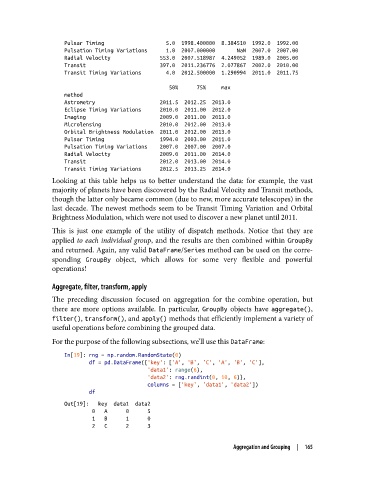
               Looking at this table helps us to better understand the data: for example, the vast
               majority of planets have been discovered by the Radial Velocity and Transit methods,
               though the latter only became common (due to new, more accurate telescopes) in the
               last decade. The newest methods seem to be Transit Timing Variation and Orbital
               Brightness Modulation, which were not used to discover a new planet until 2011.

               This is just one example of the utility of dispatch methods. Notice that they are
               applied to each individual group, and the results are then combined within GroupBy
               and returned. Again, any valid DataFrame/Series method can be used on the corre‐
               sponding GroupBy  object, which allows for some very flexible and powerful
               operations!

               Aggregate, filter, transform, apply

               The preceding discussion focused on aggregation for the combine operation, but
               there are more options available. In particular, GroupBy  objects have aggregate(),
               filter(), transform(), and apply() methods that efficiently implement a variety of
               useful operations before combining the grouped data.
               For the purpose of the following subsections, we’ll use this DataFrame:

                   In[19]: rng = np.random.RandomState(0)
                           df = pd.DataFrame({'key': ['A', 'B', 'C', 'A', 'B', 'C'],
                                              'data1': range(6),
                                              'data2': rng.randint(0, 10, 6)},
                                              columns = ['key', 'data1', 'data2'])
                           df
                   Out[19]:   key  data1  data2
                            0   A      0      5
                            1   B      1      0
                            2   C      2      3

                                                                 Aggregation and Grouping  |  165

