


Page 179 - Python Data Science Handbook
P. 179
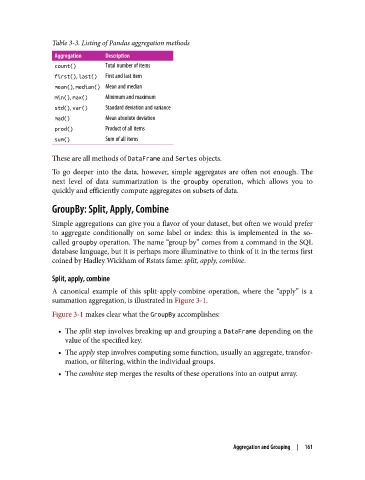
Table 3-3. Listing of Pandas aggregation methods

                Aggregation   Description
                count()       Total number of items
                first(), last()  First and last item
                mean(), median() Mean and median
                min(), max()  Minimum and maximum
                std(), var()  Standard deviation and variance
                mad()         Mean absolute deviation
                prod()        Product of all items
                sum()         Sum of all items
               These are all methods of DataFrame and Series objects.

               To go deeper into the data, however, simple aggregates are often not enough. The
               next level of data summarization is the groupby  operation, which allows you to
               quickly and efficiently compute aggregates on subsets of data.

               GroupBy: Split, Apply, Combine

               Simple aggregations can give you a flavor of your dataset, but often we would prefer
               to aggregate conditionally on some label or index: this is implemented in the so-
               called groupby operation. The name “group by” comes from a command in the SQL
               database language, but it is perhaps more illuminative to think of it in the terms first
               coined by Hadley Wickham of Rstats fame: split, apply, combine.

               Split, apply, combine
               A canonical example of this split-apply-combine operation, where the “apply” is a
               summation aggregation, is illustrated in Figure 3-1.
               Figure 3-1 makes clear what the GroupBy accomplishes:

                 • The split step involves breaking up and grouping a DataFrame depending on the
                   value of the specified key.
                 • The apply step involves computing some function, usually an aggregate, transfor‐
                   mation, or filtering, within the individual groups.

                 • The combine step merges the results of these operations into an output array.


                                                                 Aggregation and Grouping  |  161

