


Page 184 - Python Data Science Handbook
P. 184
3   A      3      3
                            4   B      4      7
                            5   C      5      9

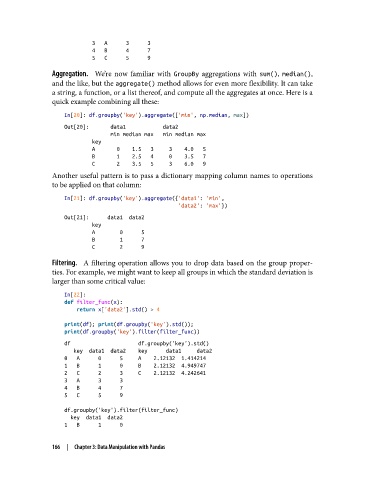
               Aggregation.     We’re now familiar with GroupBy  aggregations with sum(), median(),
               and the like, but the aggregate() method allows for even more flexibility. It can take
               a string, a function, or a list thereof, and compute all the aggregates at once. Here is a
               quick example combining all these:
                   In[20]: df.groupby('key').aggregate(['min', np.median, max])
                   Out[20]:       data1            data2
                                  min median max   min median max
                            key
                            A       0    1.5   3     3    4.0   5
                            B       1    2.5   4     0    3.5   7
                            C       2    3.5   5     3    6.0   9
               Another useful pattern is to pass a dictionary mapping column names to operations
               to be applied on that column:

                   In[21]: df.groupby('key').aggregate({'data1': 'min',
                                                        'data2': 'max'})
                   Out[21]:      data1  data2
                            key
                            A        0      5
                            B        1      7
                            C        2      9
               Filtering.    A filtering operation allows you to drop data based on the group proper‐
               ties. For example, we might want to keep all groups in which the standard deviation is
               larger than some critical value:
                   In[22]:
                   def filter_func(x):
                       return x['data2'].std() > 4
                   print(df); print(df.groupby('key').std());
                   print(df.groupby('key').filter(filter_func))
                   df                      df.groupby('key').std()
                      key  data1  data2    key      data1     data2
                   0   A      0      5     A    2.12132  1.414214
                   1   B      1      0     B    2.12132  4.949747
                   2   C      2      3     C    2.12132  4.242641
                   3   A      3      3
                   4   B      4      7
                   5   C      5      9
                   df.groupby('key').filter(filter_func)
                     key  data1  data2
                   1   B      1      0

               166  |  Chapter 3: Data Manipulation with Pandas

