


Page 191 - Python Data Science Handbook
P. 191
Additional pivot table options
               The full call signature of the pivot_table method of DataFrames is as follows:

                   # call signature as of Pandas 0.18
                   DataFrame.pivot_table(data, values=None, index=None, columns=None,
                                         aggfunc='mean', fill_value=None, margins=False,
                                         dropna=True, margins_name='All')
               We’ve already seen examples of the first three arguments; here we’ll take a quick look
               at the remaining ones. Two of the options, fill_value and dropna, have to do with
               missing data and are fairly straightforward; we will not show examples of them here.
               The aggfunc keyword controls what type of aggregation is applied, which is a mean
               by default. As in the GroupBy, the aggregation specification can be a string represent‐
               ing one of several common choices ('sum', 'mean', 'count', 'min', 'max', etc.) or a
               function that implements an aggregation (np.sum(), min(), sum(), etc.). Additionally,
               it can be specified as a dictionary mapping a column to any of the above desired
               options:

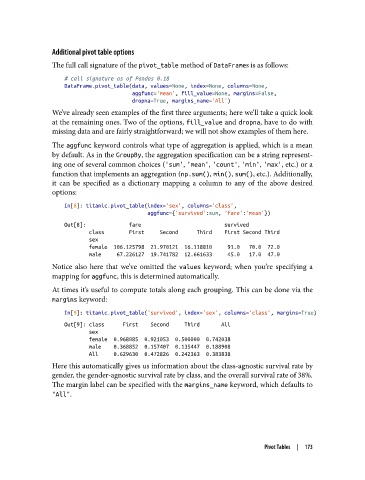
                   In[8]: titanic.pivot_table(index='sex', columns='class',
                                              aggfunc={'survived':sum, 'fare':'mean'})
                   Out[8]:              fare                           survived
                           class        First     Second      Third    First Second Third
                           sex
                           female  106.125798  21.970121  16.118810     91.0   70.0  72.0
                           male     67.226127  19.741782  12.661633     45.0   17.0  47.0
               Notice also here that we’ve omitted the values  keyword; when you’re specifying a
               mapping for aggfunc, this is determined automatically.
               At times it’s useful to compute totals along each grouping. This can be done via the
               margins keyword:
                   In[9]: titanic.pivot_table('survived', index='sex', columns='class', margins=True)
                   Out[9]: class      First    Second     Third       All
                           sex
                           female  0.968085  0.921053  0.500000  0.742038
                           male    0.368852  0.157407  0.135447  0.188908
                           All     0.629630  0.472826  0.242363  0.383838
               Here this automatically gives us information about the class-agnostic survival rate by
               gender, the gender-agnostic survival rate by class, and the overall survival rate of 38%.
               The margin label can be specified with the margins_name keyword, which defaults to
               "All".


                                                                          Pivot Tables  |  173

