


Page 194 - Python Data Science Handbook
P. 194
Next we set the day column to integers; previously it had been a string because some
               columns in the dataset contained the value 'null':

                   In[17]: # set 'day' column to integer; it originally was a string due to nulls
                           births['day'] = births['day'].astype(int)
               Finally, we can combine the day, month, and year to create a Date index (see “Work‐
               ing with Time Series” on page 188). This allows us to quickly compute the weekday
               corresponding to each row:

                   In[18]: # create a datetime index from the year, month, day
                           births.index = pd.to_datetime(10000 * births.year +
                                                         100 * births.month +
                                                         births.day, format='%Y%m%d')
                           births['dayofweek'] = births.index.dayofweek
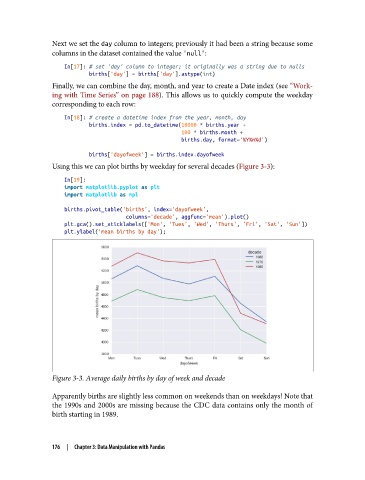
               Using this we can plot births by weekday for several decades (Figure 3-3):
                   In[19]:
                   import matplotlib.pyplot as plt
                   import matplotlib as mpl

                   births.pivot_table('births', index='dayofweek',
                                       columns='decade', aggfunc='mean').plot()
                   plt.gca().set_xticklabels(['Mon', 'Tues', 'Wed', 'Thurs', 'Fri', 'Sat', 'Sun'])
                   plt.ylabel('mean births by day');


               Figure 3-3. Average daily births by day of week and decade

               Apparently births are slightly less common on weekends than on weekdays! Note that
               the 1990s and 2000s are missing because the CDC data contains only the month of
               birth starting in 1989.


               176  |  Chapter 3: Data Manipulation with Pandas

