


Page 320 - Python Data Science Handbook
P. 320
The additional arguments to Basemap for this view specify the latitude (lat) and lon‐
               gitude (lon) of the lower-left corner (llcrnr) and upper-right corner (urcrnr) for the
               desired map, in units of degrees.

               Pseudo-cylindrical projections
               Pseudo-cylindrical projections relax the requirement that meridians (lines of constant
               longitude) remain vertical; this can give better properties near the poles of the projec‐
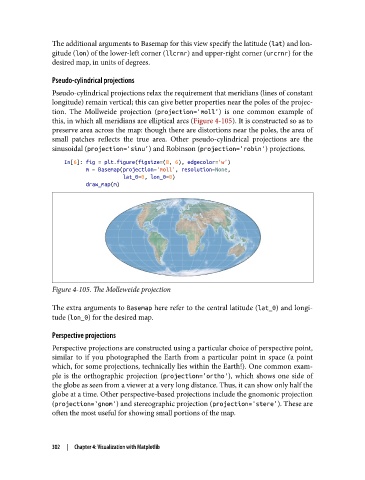
               tion. The Mollweide projection (projection='moll') is one common example of
               this, in which all meridians are elliptical arcs (Figure 4-105). It is constructed so as to
               preserve area across the map: though there are distortions near the poles, the area of
               small patches reflects the true area. Other pseudo-cylindrical projections are the
               sinusoidal (projection='sinu') and Robinson (projection='robin') projections.
                   In[6]: fig = plt.figure(figsize=(8, 6), edgecolor='w')
                          m = Basemap(projection='moll', resolution=None,
                                      lat_0=0, lon_0=0)
                          draw_map(m)


               Figure 4-105. The Molleweide projection

               The extra arguments to Basemap here refer to the central latitude (lat_0) and longi‐
               tude (lon_0) for the desired map.

               Perspective projections
               Perspective projections are constructed using a particular choice of perspective point,
               similar to if you photographed the Earth from a particular point in space (a point
               which, for some projections, technically lies within the Earth!). One common exam‐
               ple is the orthographic projection (projection='ortho'), which shows one side of
               the globe as seen from a viewer at a very long distance. Thus, it can show only half the
               globe at a time. Other perspective-based projections include the gnomonic projection
               (projection='gnom') and stereographic projection (projection='stere'). These are
               often the most useful for showing small portions of the map.


               302  |  Chapter 4: Visualization with Matplotlib

