


Page 319 - Python Data Science Handbook
P. 319
In[4]: from itertools import chain
                          def draw_map(m, scale=0.2):
                              # draw a shaded-relief image
                              m.shadedrelief(scale=scale)
                              # lats and longs are returned as a dictionary
                              lats = m.drawparallels(np.linspace(-90, 90, 13))
                              lons = m.drawmeridians(np.linspace(-180, 180, 13))

                              # keys contain the plt.Line2D instances
                              lat_lines = chain(*(tup[1][0] for tup in lats.items()))
                              lon_lines = chain(*(tup[1][0] for tup in lons.items()))
                              all_lines = chain(lat_lines, lon_lines)

                              # cycle through these lines and set the desired style
                              for line in all_lines:
                                  line.set(linestyle='-', alpha=0.3, color='w')

               Cylindrical projections
               The simplest of map projections are cylindrical projections, in which lines of constant
               latitude and longitude are mapped to horizontal and vertical lines, respectively. This
               type of mapping represents equatorial regions quite well, but results in extreme dis‐
               tortions near the poles. The spacing of latitude lines varies between different cylindri‐
               cal projections, leading to different conservation properties, and different distortion
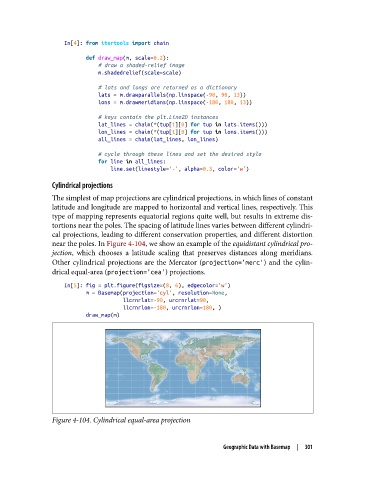
               near the poles. In Figure 4-104, we show an example of the equidistant cylindrical pro‐
               jection, which chooses a latitude scaling that preserves distances along meridians.
               Other cylindrical projections are the Mercator (projection='merc') and the cylin‐
               drical equal-area (projection='cea') projections.

                   In[5]: fig = plt.figure(figsize=(8, 6), edgecolor='w')
                          m = Basemap(projection='cyl', resolution=None,
                                      llcrnrlat=-90, urcrnrlat=90,
                                      llcrnrlon=-180, urcrnrlon=180, )
                          draw_map(m)


               Figure 4-104. Cylindrical equal-area projection


                                                               Geographic Data with Basemap  |  301

