


Page 347 - Python Data Science Handbook
P. 347
Also surprisingly, the 80-year-old women seem to outperform everyone  in terms of
               their split time. This is probably due to the fact that we’re estimating the distribution
               from small numbers, as there are only a handful of runners in that range:
                   In[38]: (data.age > 80).sum()
                   Out[38]: 7
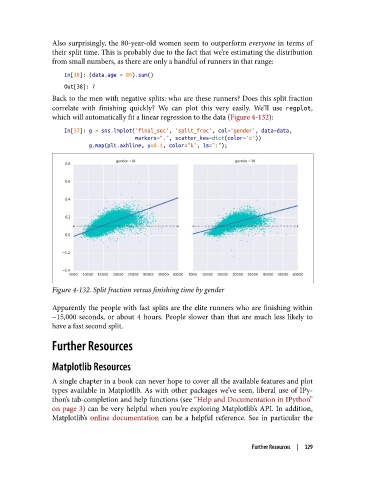
               Back to the men with negative splits: who are these runners? Does this split fraction
               correlate with finishing quickly? We can plot this very easily. We’ll use regplot,
               which will automatically fit a linear regression to the data (Figure 4-132):

                   In[37]: g = sns.lmplot('final_sec', 'split_frac', col='gender', data=data,
                                          markers=".", scatter_kws=dict(color='c'))
                           g.map(plt.axhline, y=0.1, color="k", ls=":");


               Figure 4-132. Split fraction versus finishing time by gender

               Apparently the people with fast splits are the elite runners who are finishing within
               ~15,000 seconds, or about 4 hours. People slower than that are much less likely to
               have a fast second split.

               Further Resources


               Matplotlib Resources

               A single chapter in a book can never hope to cover all the available features and plot
               types available in Matplotlib. As with other packages we’ve seen, liberal use of IPy‐
               thon’s tab-completion and help functions (see “Help and Documentation in IPython”
               on page 3) can be very helpful when you’re exploring Matplotlib’s API. In addition,
               Matplotlib’s online documentation  can be a helpful reference. See in particular the


                                                                       Further Resources  |  329

