


Page 352 - Python Data Science Handbook
P. 352
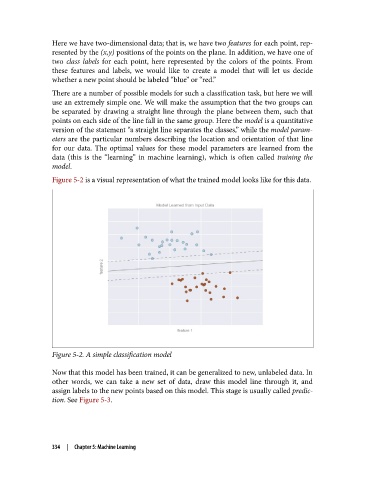
Here we have two-dimensional data; that is, we have two features for each point, rep‐
               resented by the (x,y) positions of the points on the plane. In addition, we have one of
               two class labels  for each point, here represented by the colors of the points. From
               these features and labels, we would like to create a model that will let us decide
               whether a new point should be labeled “blue” or “red.”
               There are a number of possible models for such a classification task, but here we will
               use an extremely simple one. We will make the assumption that the two groups can
               be separated by drawing a straight line through the plane between them, such that
               points on each side of the line fall in the same group. Here the model is a quantitative
               version of the statement “a straight line separates the classes,” while the model param‐
               eters  are the particular numbers describing the location and orientation of that line
               for our data. The optimal values for these model parameters are learned from the
               data (this is the “learning” in machine learning), which is often called training the
               model.
               Figure 5-2 is a visual representation of what the trained model looks like for this data.


               Figure 5-2. A simple classification model

               Now that this model has been trained, it can be generalized to new, unlabeled data. In
               other words, we can take a new set of data, draw this model line through it, and
               assign labels to the new points based on this model. This stage is usually called predic‐
               tion. See Figure 5-3.


               334  |  Chapter 5: Machine Learning

