


Page 351 - Python Data Science Handbook
P. 351
identify distinct groups of data, while dimensionality reduction algorithms search for
               more succinct representations of the data. We will see examples of both types of
               unsupervised learning in the following section.
               In addition, there are so-called semi-supervised learning  methods, which fall some‐
               where between supervised learning and unsupervised learning. Semi-supervised
               learning methods are often useful when only incomplete labels are available.

               Qualitative Examples of Machine Learning Applications

               To make these ideas more concrete, let’s take a look at a few very simple examples of a
               machine learning task. These examples are meant to give an intuitive, non-
               quantitative overview of the types of machine learning tasks we will be looking at in
               this chapter. In later sections, we will go into more depth regarding the particular
               models and how they are used. For a preview of these more technical aspects, you can
               find the Python source that generates the figures in the online appendix.

               Classification: Predicting discrete labels
               We will first take a look at a simple classification task, in which you are given a set of
               labeled points and want to use these to classify some unlabeled points.
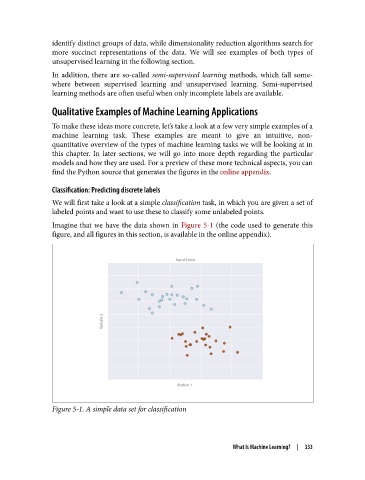
               Imagine that we have the data shown in Figure 5-1  (the code used to generate this
               figure, and all figures in this section, is available in the online appendix).


               Figure 5-1. A simple data set for classification


                                                                 What Is Machine Learning?  |  333

