


Page 343 - Python Data Science Handbook
P. 343
Out[29]:    age gender    split    final  split_sec  final_sec  split_frac
                            0   33      M 01:05:38 02:08:51     3938.0     7731.0   -0.018756
                            1   32      M 01:06:26 02:09:28     3986.0     7768.0   -0.026262
                            2   31      M 01:06:49 02:10:42     4009.0     7842.0   -0.022443
                            3   38      M 01:06:16 02:13:45     3976.0     8025.0    0.009097
                            4   31      M 01:06:32 02:13:59     3992.0     8039.0    0.006842
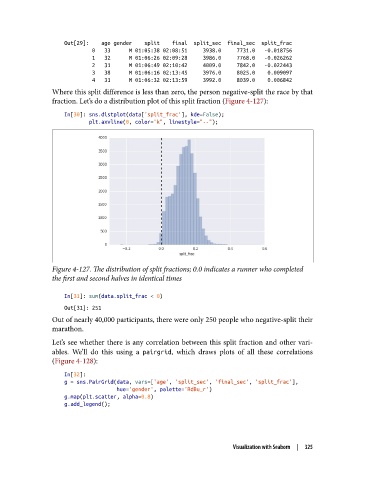
               Where this split difference is less than zero, the person negative-split the race by that
               fraction. Let’s do a distribution plot of this split fraction (Figure 4-127):

                   In[30]: sns.distplot(data['split_frac'], kde=False);
                           plt.axvline(0, color="k", linestyle="--");


               Figure 4-127. The distribution of split fractions; 0.0 indicates a runner who completed
               the first and second halves in identical times

                   In[31]: sum(data.split_frac < 0)
                   Out[31]: 251
               Out of nearly 40,000 participants, there were only 250 people who negative-split their
               marathon.
               Let’s see whether there is any correlation between this split fraction and other vari‐
               ables. We’ll do this using a pairgrid, which draws plots of all these correlations
               (Figure 4-128):

                   In[32]:
                   g = sns.PairGrid(data, vars=['age', 'split_sec', 'final_sec', 'split_frac'],
                                    hue='gender', palette='RdBu_r')
                   g.map(plt.scatter, alpha=0.8)
                   g.add_legend();


                                                                 Visualization with Seaborn  |  325

