


Page 357 - Python Data Science Handbook
P. 357
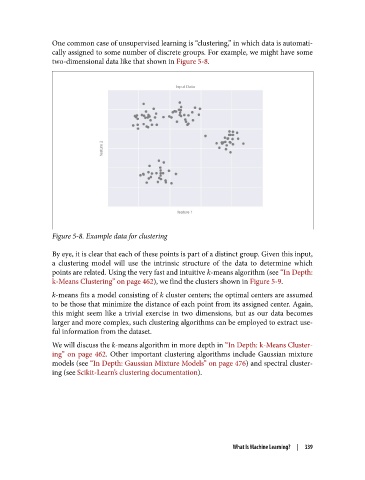
One common case of unsupervised learning is “clustering,” in which data is automati‐
               cally assigned to some number of discrete groups. For example, we might have some
               two-dimensional data like that shown in Figure 5-8.


               Figure 5-8. Example data for clustering

               By eye, it is clear that each of these points is part of a distinct group. Given this input,
               a clustering model will use the intrinsic structure of the data to determine which
               points are related. Using the very fast and intuitive k-means algorithm (see “In Depth:
               k-Means Clustering” on page 462), we find the clusters shown in Figure 5-9.
               k-means fits a model consisting of k cluster centers; the optimal centers are assumed
               to be those that minimize the distance of each point from its assigned center. Again,
               this might seem like a trivial exercise in two dimensions, but as our data becomes
               larger and more complex, such clustering algorithms can be employed to extract use‐
               ful information from the dataset.
               We will discuss the k-means algorithm in more depth in “In Depth: k-Means Cluster‐
               ing”  on page 462. Other important clustering algorithms include Gaussian mixture
               models (see “In Depth: Gaussian Mixture Models” on page 476) and spectral cluster‐
               ing (see Scikit-Learn’s clustering documentation).


                                                                 What Is Machine Learning?  |  339

