


Page 365 - Python Data Science Handbook
P. 365
In practice, these principles make Scikit-Learn very easy to use, once the basic princi‐
               ples are understood. Every machine learning algorithm in Scikit-Learn is imple‐
               mented via the Estimator API, which provides a consistent interface for a wide range
               of machine learning applications.

               Basics of the API
               Most commonly, the steps in using the Scikit-Learn estimator API are as follows (we
               will step through a handful of detailed examples in the sections that follow):

                1. Choose a class of model by importing the appropriate estimator class from Scikit-
                   Learn.

                2. Choose model hyperparameters by instantiating this class with desired values.
                3. Arrange data into a features matrix and target vector following the discussion
                   from before.
                4. Fit the model to your data by calling the fit() method of the model instance.
                5. Apply the model to new data:

                   • For supervised learning, often we predict labels for unknown data using the
                     predict() method.
                   • For unsupervised learning, we often transform or infer properties of the data
                     using the transform() or predict() method.


               We will now step through several simple examples of applying supervised and unsu‐
               pervised learning methods.

               Supervised learning example: Simple linear regression
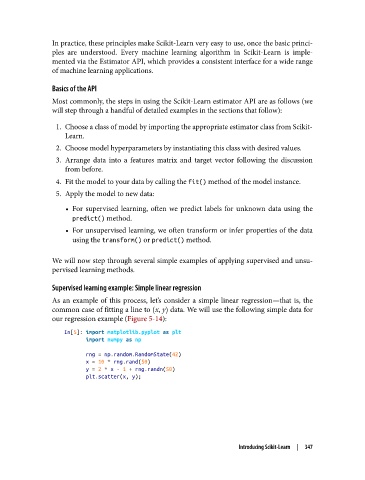
               As an example of this process, let’s consider a simple linear regression—that is, the
               common case of fitting a line to  x, y  data. We will use the following simple data for
               our regression example (Figure 5-14):

                   In[5]: import matplotlib.pyplot as plt
                          import numpy as np
                          rng = np.random.RandomState(42)
                          x = 10 * rng.rand(50)
                          y = 2 * x - 1 + rng.randn(50)
                          plt.scatter(x, y);


                                                                   Introducing Scikit-Learn  |  347

