


Page 370 - Python Data Science Handbook
P. 370
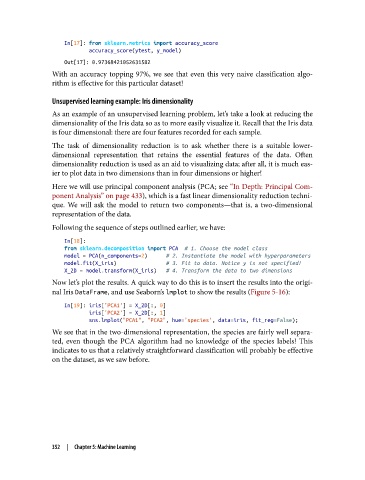
In[17]: from sklearn.metrics import accuracy_score
                           accuracy_score(ytest, y_model)
                   Out[17]: 0.97368421052631582
               With an accuracy topping 97%, we see that even this very naive classification algo‐
               rithm is effective for this particular dataset!

               Unsupervised learning example: Iris dimensionality

               As an example of an unsupervised learning problem, let’s take a look at reducing the
               dimensionality of the Iris data so as to more easily visualize it. Recall that the Iris data
               is four dimensional: there are four features recorded for each sample.
               The task of dimensionality reduction is to ask whether there is a suitable lower-
               dimensional representation that retains the essential features of the data. Often
               dimensionality reduction is used as an aid to visualizing data; after all, it is much eas‐
               ier to plot data in two dimensions than in four dimensions or higher!
               Here we will use principal component analysis (PCA; see “In Depth: Principal Com‐
               ponent Analysis” on page 433), which is a fast linear dimensionality reduction techni‐
               que. We will ask the model to return two components—that is, a two-dimensional
               representation of the data.
               Following the sequence of steps outlined earlier, we have:

                   In[18]:
                   from sklearn.decomposition import PCA  # 1. Choose the model class
                   model = PCA(n_components=2)      # 2. Instantiate the model with hyperparameters
                   model.fit(X_iris)                # 3. Fit to data. Notice y is not specified!
                   X_2D = model.transform(X_iris)   # 4. Transform the data to two dimensions
               Now let’s plot the results. A quick way to do this is to insert the results into the origi‐
               nal Iris DataFrame, and use Seaborn’s lmplot to show the results (Figure 5-16):

                   In[19]: iris['PCA1'] = X_2D[:, 0]
                           iris['PCA2'] = X_2D[:, 1]
                           sns.lmplot("PCA1", "PCA2", hue='species', data=iris, fit_reg=False);
               We see that in the two-dimensional representation, the species are fairly well separa‐
               ted, even though the PCA algorithm had no knowledge of the species labels! This
               indicates to us that a relatively straightforward classification will probably be effective
               on the dataset, as we saw before.


               352  |  Chapter 5: Machine Learning

