


Page 366 - Python Data Science Handbook
P. 366
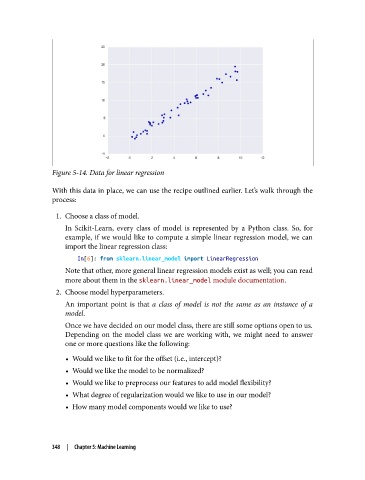
Figure 5-14. Data for linear regression

               With this data in place, we can use the recipe outlined earlier. Let’s walk through the
               process:
                1. Choose a class of model.
                   In Scikit-Learn, every class of model is represented by a Python class. So, for
                   example, if we would like to compute a simple linear regression model, we can
                   import the linear regression class:
                      In[6]: from sklearn.linear_model import LinearRegression
                   Note that other, more general linear regression models exist as well; you can read
                   more about them in the sklearn.linear_model module documentation.
                2. Choose model hyperparameters.

                   An important point is that a class of model is not the same as an instance of a
                   model.
                   Once we have decided on our model class, there are still some options open to us.
                   Depending on the model class we are working with, we might need to answer
                   one or more questions like the following:

                   • Would we like to fit for the offset (i.e., intercept)?
                   • Would we like the model to be normalized?
                   • Would we like to preprocess our features to add model flexibility?
                   • What degree of regularization would we like to use in our model?
                   • How many model components would we like to use?


               348  |  Chapter 5: Machine Learning

