


Page 496 - Python Data Science Handbook
P. 496
(although it may be possible to use a bootstrap approach to estimate this uncertainty).
               For this, we must think about generalizing the model.
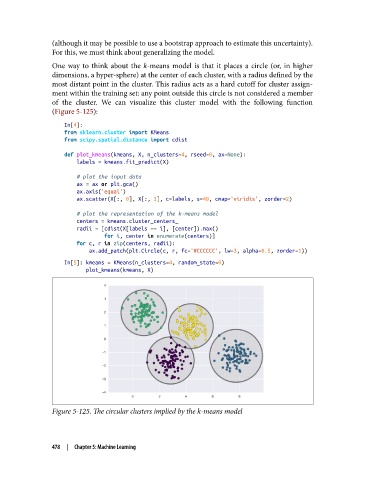
               One way to think about the k-means model is that it places a circle (or, in higher
               dimensions, a hyper-sphere) at the center of each cluster, with a radius defined by the
               most distant point in the cluster. This radius acts as a hard cutoff for cluster assign‐
               ment within the training set: any point outside this circle is not considered a member
               of the cluster. We can visualize this cluster model with the following function
               (Figure 5-125):

                   In[4]:
                   from sklearn.cluster import KMeans
                   from scipy.spatial.distance import cdist
                   def plot_kmeans(kmeans, X, n_clusters=4, rseed=0, ax=None):
                       labels = kmeans.fit_predict(X)

                       # plot the input data
                       ax = ax or plt.gca()
                       ax.axis('equal')
                       ax.scatter(X[:, 0], X[:, 1], c=labels, s=40, cmap='viridis', zorder=2)
                       # plot the representation of the k-means model
                       centers = kmeans.cluster_centers_
                       radii = [cdist(X[labels == i], [center]).max()
                                for i, center in enumerate(centers)]
                       for c, r in zip(centers, radii):
                           ax.add_patch(plt.Circle(c, r, fc='#CCCCCC', lw=3, alpha=0.5, zorder=1))
                   In[5]: kmeans = KMeans(n_clusters=4, random_state=0)
                          plot_kmeans(kmeans, X)


               Figure 5-125. The circular clusters implied by the k-means model


               478  |  Chapter 5: Machine Learning

