


Page 495 - Python Data Science Handbook
P. 495
In[1]: %matplotlib inline
                          import matplotlib.pyplot as plt
                          import seaborn as sns; sns.set()
                          import numpy as np
               Motivating GMM: Weaknesses of k-Means

               Let’s take a look at some of the weaknesses of k-means and think about how we might
               improve the cluster model. As we saw in the previous section, given simple, well-
               separated data, k-means finds suitable clustering results.
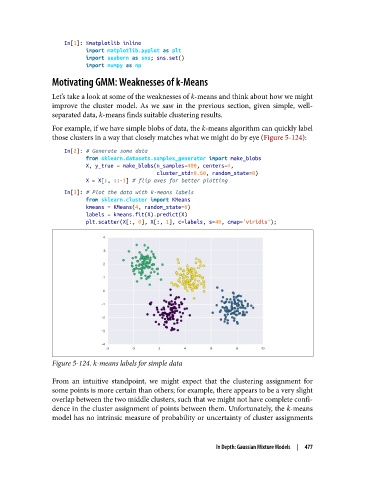
               For example, if we have simple blobs of data, the k-means algorithm can quickly label
               those clusters in a way that closely matches what we might do by eye (Figure 5-124):
                   In[2]: # Generate some data
                          from sklearn.datasets.samples_generator import make_blobs
                          X, y_true = make_blobs(n_samples=400, centers=4,
                                                 cluster_std=0.60, random_state=0)
                          X = X[:, ::-1] # flip axes for better plotting
                   In[3]: # Plot the data with k-means labels
                          from sklearn.cluster import KMeans
                          kmeans = KMeans(4, random_state=0)
                          labels = kmeans.fit(X).predict(X)
                          plt.scatter(X[:, 0], X[:, 1], c=labels, s=40, cmap='viridis');


               Figure 5-124. k-means labels for simple data

               From an intuitive standpoint, we might expect that the clustering assignment for
               some points is more certain than others; for example, there appears to be a very slight
               overlap between the two middle clusters, such that we might not have complete confi‐
               dence in the cluster assignment of points between them. Unfortunately, the k-means
               model has no intrinsic measure of probability or uncertainty of cluster assignments


                                                             In Depth: Gaussian Mixture Models  |  477

