


Page 499 - Python Data Science Handbook
P. 499
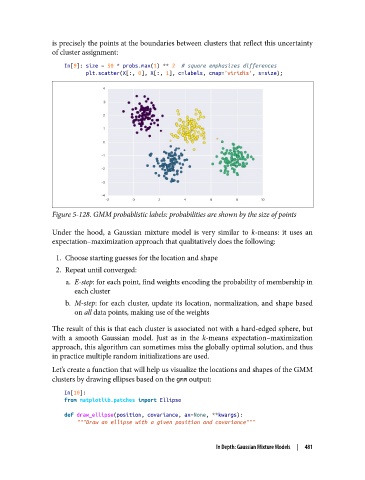
is precisely the points at the boundaries between clusters that reflect this uncertainty
               of cluster assignment:

                   In[9]: size = 50 * probs.max(1) ** 2  # square emphasizes differences
                          plt.scatter(X[:, 0], X[:, 1], c=labels, cmap='viridis', s=size);


               Figure 5-128. GMM probablistic labels: probabilities are shown by the size of points

               Under the hood, a Gaussian mixture model is very similar to k-means: it uses an
               expectation–maximization approach that qualitatively does the following:

                1. Choose starting guesses for the location and shape
                2. Repeat until converged:
                   a. E-step: for each point, find weights encoding the probability of membership in
                      each cluster
                   b. M-step: for each cluster, update its location, normalization, and shape based
                      on all data points, making use of the weights

               The result of this is that each cluster is associated not with a hard-edged sphere, but
               with a smooth Gaussian model. Just as in the k-means expectation–maximization
               approach, this algorithm can sometimes miss the globally optimal solution, and thus
               in practice multiple random initializations are used.

               Let’s create a function that will help us visualize the locations and shapes of the GMM
               clusters by drawing ellipses based on the gmm output:

                   In[10]:
                   from matplotlib.patches import Ellipse

                   def draw_ellipse(position, covariance, ax=None, **kwargs):
                       """Draw an ellipse with a given position and covariance"""


                                                             In Depth: Gaussian Mixture Models  |  481

