


Page 497 - Python Data Science Handbook
P. 497
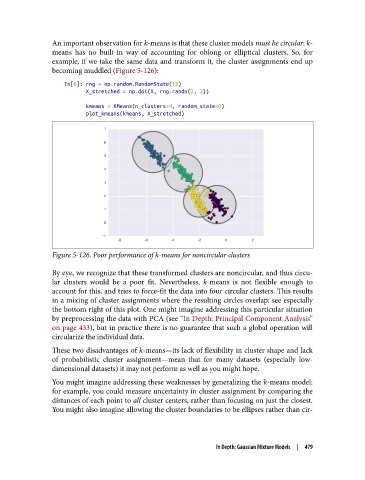
An important observation for k-means is that these cluster models must be circular: k-
               means has no built-in way of accounting for oblong or elliptical clusters. So, for
               example, if we take the same data and transform it, the cluster assignments end up
               becoming muddled (Figure 5-126):

                   In[6]: rng = np.random.RandomState(13)
                          X_stretched = np.dot(X, rng.randn(2, 2))

                          kmeans = KMeans(n_clusters=4, random_state=0)
                          plot_kmeans(kmeans, X_stretched)


               Figure 5-126. Poor performance of k-means for noncircular clusters

               By eye, we recognize that these transformed clusters are noncircular, and thus circu‐
               lar clusters would be a poor fit. Nevertheless, k-means is not flexible enough to
               account for this, and tries to force-fit the data into four circular clusters. This results
               in a mixing of cluster assignments where the resulting circles overlap: see especially
               the bottom right of this plot. One might imagine addressing this particular situation
               by preprocessing the data with PCA (see “In Depth: Principal Component Analysis”
               on page 433), but in practice there is no guarantee that such a global operation will
               circularize the individual data.

               These two disadvantages of k-means—its lack of flexibility in cluster shape and lack
               of probabilistic cluster assignment—mean that for many datasets (especially low-
               dimensional datasets) it may not perform as well as you might hope.
               You might imagine addressing these weaknesses by generalizing the k-means model:
               for example, you could measure uncertainty in cluster assignment by comparing the
               distances of each point to all cluster centers, rather than focusing on just the closest.
               You might also imagine allowing the cluster boundaries to be ellipses rather than cir‐


                                                             In Depth: Gaussian Mixture Models  |  479

