


Page 498 - Python Data Science Handbook
P. 498
cles, so as to account for noncircular clusters. It turns out these are two essential com‐
               ponents of a different type of clustering model, Gaussian mixture models.

               Generalizing E–M: Gaussian Mixture Models

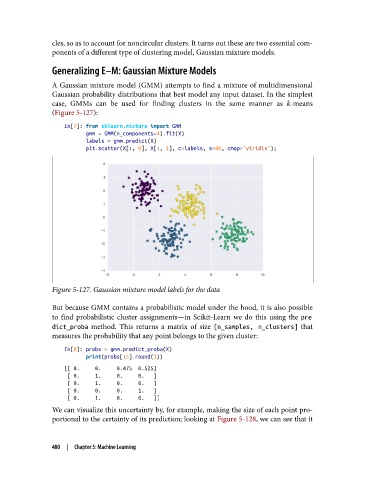
               A Gaussian mixture model (GMM) attempts to find a mixture of multidimensional
               Gaussian probability distributions that best model any input dataset. In the simplest
               case, GMMs can be used for finding clusters in the same manner as k-means
               (Figure 5-127):

                   In[7]: from sklearn.mixture import GMM
                          gmm = GMM(n_components=4).fit(X)
                          labels = gmm.predict(X)
                          plt.scatter(X[:, 0], X[:, 1], c=labels, s=40, cmap='viridis');


               Figure 5-127. Gaussian mixture model labels for the data

               But because GMM contains a probabilistic model under the hood, it is also possible
               to find probabilistic cluster assignments—in Scikit-Learn we do this using the pre
               dict_proba  method. This returns a matrix of size [n_samples, n_clusters]  that
               measures the probability that any point belongs to the given cluster:

                   In[8]: probs = gmm.predict_proba(X)
                          print(probs[:5].round(3))
                   [[ 0.     0.     0.475  0.525]
                    [ 0.     1.     0.     0.   ]
                    [ 0.     1.     0.     0.   ]
                    [ 0.     0.     0.     1.   ]
                    [ 0.     1.     0.     0.   ]]
               We can visualize this uncertainty by, for example, making the size of each point pro‐
               portional to the certainty of its prediction; looking at Figure 5-128, we can see that it


               480  |  Chapter 5: Machine Learning

