


Page 515 - Python Data Science Handbook
P. 515
kernel bandwidth, which is a free parameter, using Scikit-Learn’s standard cross-
               validation tools, as we will soon see.
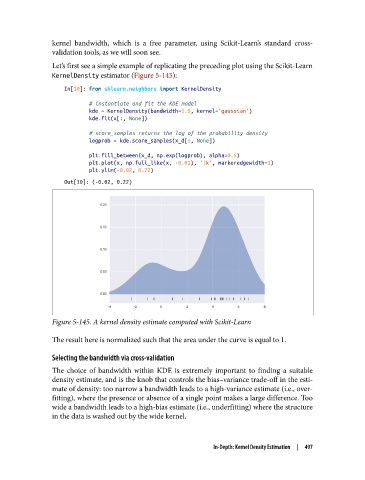
               Let’s first see a simple example of replicating the preceding plot using the Scikit-Learn
               KernelDensity estimator (Figure 5-145):

                   In[10]: from sklearn.neighbors import KernelDensity
                           # instantiate and fit the KDE model
                           kde = KernelDensity(bandwidth=1.0, kernel='gaussian')
                           kde.fit(x[:, None])
                           # score_samples returns the log of the probability density
                           logprob = kde.score_samples(x_d[:, None])
                           plt.fill_between(x_d, np.exp(logprob), alpha=0.5)
                           plt.plot(x, np.full_like(x, -0.01), '|k', markeredgewidth=1)
                           plt.ylim(-0.02, 0.22)
                   Out[10]: (-0.02, 0.22)


               Figure 5-145. A kernel density estimate computed with Scikit-Learn


               The result here is normalized such that the area under the curve is equal to 1.

               Selecting the bandwidth via cross-validation
               The choice of bandwidth within KDE is extremely important to finding a suitable
               density estimate, and is the knob that controls the bias–variance trade-off in the esti‐
               mate of density: too narrow a bandwidth leads to a high-variance estimate (i.e., over‐
               fitting), where the presence or absence of a single point makes a large difference. Too
               wide a bandwidth leads to a high-bias estimate (i.e., underfitting) where the structure
               in the data is washed out by the wide kernel.


                                                            In-Depth: Kernel Density Estimation  |  497

