


Page 16 - Spotlight A+ Form 4 & 5 Chemistry KSSM
P. 16
Form
           4
                      Chemistry   Chapter 5 Chemical Bond

              Conclusion:                                     2.  A spatula of naphthalene, C H  powder is
                                                                                        10  8
              The hypothesis is accepted. Magnesium chloride,   placed in another test tube.
              MgCl  is an ionic compound which is soluble in     3.  The  two  test  tubes  are  heated  in  a  beaker
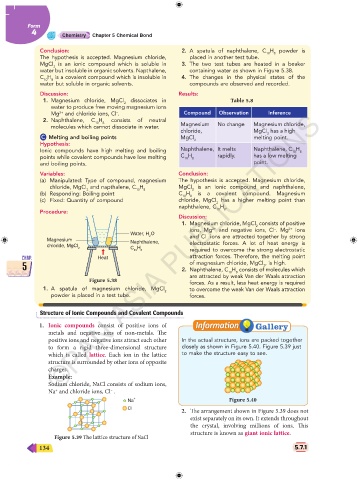
                   2
              water but insoluble in organic solvents. Napthalene,   containing water as shown in Figure 5.38.
              C H  is a covalent compound which is insoluble in     4.  The changes in the physical states of the
               10  8
              water but soluble in organic solvents.           compounds are observed and recorded.
              Discussion:                                   Results:
                1.  Magnesium chloride, MgCl  dissociates in                 Table 5.8
                                          2
                  water to produce free moving magnesium ions
                  Mg  and chloride ions, Cl .                Compound    Observation     Inference
                                       –
                    2+
                   +©PAN ASIA PUBLICATIONS
                2.  Naphthalene, C H  consists of neutral
                                10  8                       Magnesium   No change   Magnesium chloride,
                  molecules which cannot dissociate in water.
                                                            chloride,               MgCl  has a high
                                                                                         2
               C  Melting and boiling points                MgCl                    melting point.
                                                                 2
              Hypothesis:
              Ionic compounds have high melting and boiling   Naphthalene,  It melts   Naphthalene, C H
                                                                                                   8
                                                                                                 10
              points while covalent compounds have low melting   C H 8  rapidly.    has a low melting
                                                              10
              and boiling points.                                                   point.
              Variables:                                    Conclusion:
              (a)  Manipulated: Type of compound, magnesium   The hypothesis is accepted. Magnesium chloride,
                 chloride, MgCl  and napthalene, C H        MgCl  is an ionic compound and naphthalene,
                             2                10  8             2
              (b)  Responding: Boiling point                C H  is a covalent compound. Magnesium
                                                               8
                                                             10
              (c)  Fixed: Quantity of compound              chloride, MgCl  has a higher melting point than
                                                                        2
                                                            naphthalene, C H .
              Procedure:                                                10  8
                                                            Discussion:
                                                              1.  Magnesium chloride, MgCl  consists of positive
                                                                                     2
                                                                                                2+
                                                                                           –
                                                               ions, Mg  and negative ions, Cl . Mg  ions
                                                                       2+
                                            Water, H O
                                                                     –
                                                  2            and Cl  ions are attracted together by strong
                Magnesium
                                            Naphthalene,
                chloride, MgCl                                 electrostatic forces. A lot of heat energy is
                           2                C H
                                             10  8             required to overcome the strong electrostatic
        CHAP.                    Heat                          attraction forces. Therefore, the melting point                                                                                                           CHAP.
        5                                                      of magnesium chloride, MgCl , is high.                                                                                                                     5
                                                                                       2
                                                              2.  Naphthalene, C H  consists of molecules which
                                                                            10  8
                              Figure 5.38                      are attracted by weak Van der Waals attraction
                                                               forces. As a result, less heat energy is required
                1.  A spatula of magnesium chloride, MgCl      to overcome the weak Van der Waals attraction
                                                       2
                  powder is placed in a test tube.             forces.
              Structure of Ionic Compounds and Covalent Compounds
               1.  Ionic compounds consist of positive ions of
                 metals and negative ions of non-metals. The
                 positive ions and negative ions attract each other   In the actual structure, ions are packed together
                 to form a rigid three-dimensional structure   closely as shown in Figure 5.40. Figure 5.39 just
                 which is called  lattice. Each ion  in the lattice   to make the structure easy to see.
                 structure is surrounded by other ions of opposite
                 charges.
                  Example:
                 Sodium chloride, NaCl consists of sodium ions,
                 Na  and chloride ions, Cl  .
                                     –
                                             +                              Figure 5.40
                                           Na
                                            –
                                           Cl                2.  The arrangement shown in Figure 5.39 does not
                                                               exist separately on its own. It extends throughout
                                                               the  crystal,  involving  millions  of  ions.  This
                                                               structure is known as giant ionic lattice.
                   Figure 5.39 The lattice structure of NaCl
              134                                                                                 5.7.1

