


Page 38 - Spotlight A+ Form 4 & 5 Chemistry KSSM
P. 38
Form
           5          Chemistry   Chapter 1 Redox Equilibrium

        CHAP.                                               Results:                                                                                                                                                     CHAP.
         1                          Copper, Cu                              Table 1.27                                                                                                                                    1
                                    strip
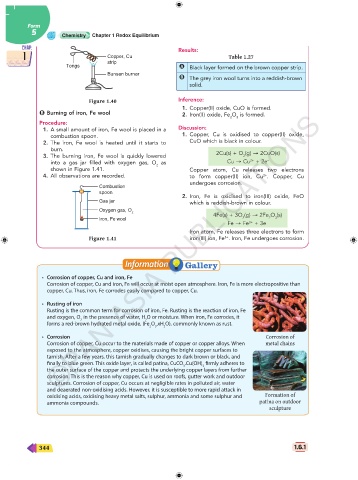
                       Tongs                                A Black layer formed on the brown copper strip.
                                    Bunsen burner
                                                            B The grey iron wool turns into a reddish-brown
                                                               solid.

                              Figure 1.40                   Inference:
                                                              1.  Copper(II) oxide, CuO is formed.
              B Burning of iron, Fe wool                      2.  Iron(II) oxide, Fe O  is formed.
                    ©PAN ASIA PUBLICATIONS
                                                                            2  3
              Procedure:
                1.  A small amount of iron, Fe wool is placed in a   Discussion:
                  combustion spoon.                           1.  Copper, Cu  is oxidised to copper(II) oxide,
                2.  The  iron, Fe wool is heated until it starts to   CuO which is black in colour.
                  burn.                                                 2Cu(s) + O (g) → 2CuO(s)
                3.  The  burning iron, Fe wool is quickly lowered                2
                                                                                   2+
                  into  a  gas  jar  filled  with  oxygen  gas,  O  as      Cu → Cu  + 2e –
                                                    2
                  shown in Figure 1.41.                          Copper  atom, Cu releases two electrons
                4.  All observations are recorded.             to  form copper(II)  ion, Cu . Copper, Cu
                                                                                       2+
                                                               undergoes corrosion.
                                  Combustion
                                  spoon
                                                              2.  Iron, Fe  is oxidised to iron(III) oxide, FeO
                                  Gas jar
                                                               which is reddish-brown in colour.
                                  Oxygen gas, O
                                                                       4Fe(s) + 3O (g) → 2Fe O (s)
                                            2
                                  Iron, Fe wool                                  2       2  3
                                                                            Fe → Fe  + 3e –
                                                                                   3+
                                                               Iron atom, Fe releases three electrons to form
                              Figure 1.41                      iron(III) ion, Fe . Iron, Fe undergoes corrosion.
                                                                           3+


               •  Corrosion of copper, Cu and iron, Fe
                 Corrosion of copper, Cu and iron, Fe will occur at moist open atmosphere. Iron, Fe is more electropositive than
                copper, Cu. Thus, iron, Fe corrodes easily compared to copper, Cu.
               •  Rusting of iron
                 Rusting is the common term for corrosion of iron, Fe. Rusting is the reaction of iron, Fe
                and oxygen, O  in the presence of water, H O or moisture. When iron, Fe corrodes, it
                           2
                                                 2
                forms a red-brown hydrated metal oxide, (Fe O .xH O), commonly known as rust.
                                                  2  3  2
               •  Corrosion                                                             Corrosion of
                 Corrosion of copper, Cu occur to the materials made of copper or copper alloys. When   metal chains
                exposed to the atmosphere, copper oxidises, causing the bright copper surfaces to
                tarnish. After a few years, this tarnish gradually changes to dark brown or black, and
                finally to blue green. This oxide layer, is called patina, CuCO .Cu(OH)  firmly adheres to
                                                                   2
                                                             3
                the outer surface of the copper and protects the underlying copper layers from further
                corrosion. This is the reason why copper, Cu is used on roofs, gutter work and outdoor
                sculptures. Corrosion of copper, Cu occurs at negligible rates in polluted air, water
                and deaerated non-oxidising acids. However, it is susceptible to more rapid attack in
                oxidising acids, oxidising heavy metal salts, sulphur, ammonia and some sulphur and   Formation of
                ammonia compounds.                                                    patina on outdoor
                                                                                         sculpture


              344                                                                                 1.6.1

