


Page 39 - Spotlight A+ Form 4 & 5 Chemistry KSSM
P. 39
Form
5
Chapter 1 Redox Equilibrium Chemistry
CHAP. Iron Rusting as a Redox Reaction (e) Redox reaction equation: CHAP.
1 1. Rusting is a metal corrosion that occurs on iron Anode: 2Fe(s) → 2Fe (aq) + 4e – 1
2+
due to redox reaction. Rusting of iron requires Cathode: O (g) + 2H O(l) + 4e → 4OH (aq)
–
–
2
2
the presence oxygen (air) and water. 2Fe(s) + O (g) + 2H O(l) → 2Fe(OH) (s)
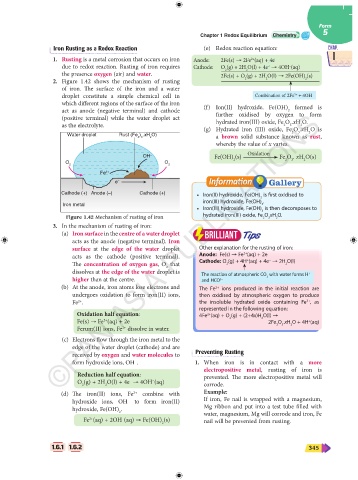
2. Figure 1.42 shows the mechanism of rusting 2 2 2
of iron. The surface of the iron and a water
droplet constitute a simple chemical cell in Combination of 2Fe + 4OH –
2+
which different regions of the surface of the iron
act as anode (negative terminal) and cathode (f) Ion(II) hydroxide, Fe(OH) formed is
2
©PAN ASIA PUBLICATIONS
(positive terminal) while the water droplet act further oxidised by oxygen to form
as the electrolyte. hydrated iron(III) oxide, Fe O .xH O.
3
2
2
(g) Hydrated iron (III) oxide, Fe O .xH O is
3
2
2
Water droplet Rust (Fe ) .xH O) a brown solid substance known as rust,
2 3 2
whereby the value of x varies.
Oxidation
OH – Fe(OH) (s) Fe O . xH O(s)
O O 2 2 3 2
2 2
Fe 2+
e –
Cathode (+) Anode (–) Cathode (+) • Iron(II) hydroxide, Fe(OH) is first oxidised to
2
iron(III) hydroxide, Fe(OH) .
Iron metal 3
• Iron(III) hydroxide, Fe(OH) is then decomposes to
3
Figure 1.42 Mechanism of rusting of iron hydrated iron(III) oxide, Fe O xH O.
2
3
2
3. In the mechanism of rusting of iron:
(a) Iron surface in the centre of a water droplet
acts as the anode (negative terminal). Iron
surface at the edge of the water droplet Other explanation for the rusting of iron:
2+
acts as the cathode (positive terminal). Anode: Fe(s) → Fe (aq) + 2e – –
+
The concentration of oxygen gas, O that Cathode: O (g) + 4H (aq) + 4e → 2H O(l)
2
2
2
dissolves at the edge of the water droplet is The reaction of atmospheric CO with water forms H +
higher than at the centre. and HCO 3− 2
(b) At the anode, iron atoms lose electrons and The Fe ions produced in the initial reaction are
2+
undergoes oxidation to form iron(II) ions, then oxidised by atmospheric oxygen to produce
2+
Fe . the insoluble hydrated oxide containing Fe , as
3+
represented in the following equation:
Oxidation half equation: 4Fe (aq) + O (g) + (2+4x)H O(l) →
2+
Fe(s) → Fe (aq) + 2e – 2 2 2Fe O .xH O + 4H (aq)
2+
+
2
3
2
Ferum(II) ions, Fe dissolve in water.
2+
(c) Electrons flow through the iron metal to the
edge of the water droplet (cathode) and are
received by oxygen and water molecules to Preventing Rusting
form hydroxide ions, OH . 1. When iron is in contact with a more
–
electropositive metal, rusting of iron is
Reduction half equation: prevented. The more electropositive metal will
O (g) + 2H O(l) + 4e → 4OH (aq)
–
−
2 2 corrode.
(d) The iron(II) ions, Fe combine with Example:
2+
hydroxide ions, OH to form iron(II) If iron, Fe nail is wrapped with a magnesium,
−
hydroxide, Fe(OH) . Mg ribbon and put into a test tube filled with
2 water, magnesium, Mg will corrode and iron, Fe
Fe (aq) + 2OH (aq) → Fe(OH) (s) nail will be prevented from rusting.
2+
−
2
1.6.1 1.6.2 345

