


Page 37 - Spotlight A+ Form 4 & 5 Chemistry KSSM
P. 37
Form
                                                                                                           5
                                                                   Chapter 1 Redox Equilibrium  Chemistry
 CHAP.                                                                 iron, Fe and are accepted by  positive  ions  CHAP.
 1                                                                     such as hydrogen ions, H  or oxygen, O
                                                                                                          2 1
                                                                                             +
                   Magnesium, Mg and iron, Fe form oxide coating       and water, H O in the electrolyte.
                                                                                  2
                   which is porous , not tightly packed and weak.
                   This oxide coating is easily peeled off and cannot
                   protect the metals from corrosion.
                                                                   Cars rust more rapidly in a country where salt is
                                                                   used to melt the snow and ice on the road.
                 Electrochemical corrosion                         Dissolved salts in the water droplet greatly
                   1.  Electrochemical  corrosion is the process   increase the conductivity of the electrolyte. Thus
                  Materials: ©PAN ASIA PUBLICATIONS
                     by which a metal is corroded through loss of   increasing the rate of corrosion.
                     electron to form a cation with the presence of
                     electrolyte when the metal is in contact with     2.  The  rate of  corrosion of magnesium, Mg
                     other less electropositive metal.              increases when magnesium, Mg is contacted
                      Example:                                      with copper, Cu. This is because magnesium,
                                                                    Mg and copper, Cu have a great difference in
                                                                    electropositivity compared to magnesium, Mg
                              (–) (+)         Electrolyte           and iron, Fe.
                              Mg Fe

                               e –
                                                                                  Mg
                               e –                                                      e –
                                                                                  Fe   e –  The rate of
                                                                   Electrochemical
                                                                                           transferring of
                                  Figure 1.38                      series                  electrons from Mg to
                                                                                           Cu is higher.
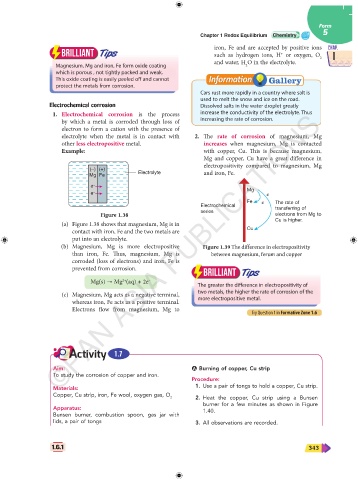
                      (a)  Figure 1.38 shows that magnesium, Mg is in
                         contact with iron, Fe and the two metals are             Cu
                         put into an electrolyte.
                      (b)  Magnesium, Mg is more electropositive    Figure 1.39 The difference in electropositivity
                         than iron, Fe. Thus, magnesium, Mg is        between magnesium, ferum and copper
                         corroded (loss of electrons) and iron, Fe is
                         prevented from corrosion.

                               Mg(s) → Mg (aq) + 2e –
                                         2+
                                                                  The greater the difference in electropositivity of
                      (c)  Magnesium, Mg acts as a negative terminal,   two metals, the higher the rate of corrosion of the
                                                                  more electropositive metal.
                         whereas iron, Fe acts as a positive terminal.
                         Electrons flow from magnesium, Mg to
                                                                                    Try Question 1 in Formative Zone 1.6


                        Activity      1.7


                  Aim:                                          A Burning of copper, Cu strip
                  To study the corrosion of copper and iron.
                                                                Procedure:
                                                                  1.  Use a pair of tongs to hold a copper, Cu strip.
                  Copper, Cu strip, iron, Fe wool, oxygen gas, O
                                                         2        2.  Heat  the copper, Cu strip using a Bunsen
                                                                    burner for a few minutes as shown in Figure
                  Apparatus:                                        1.40.
                  Bunsen burner, combustion spoon, gas jar with
                  lids, a pair of tongs                           3.  All observations are recorded.


                  1.6.1                                                                               343

