


Page 174 - Player's Handbook
P. 174
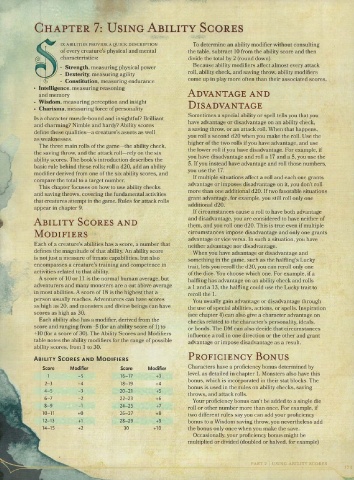
CHAPTER 7: USINGABILITY                                SCORES


                     IX ABILlTIES  PROVIDE  A QUICK  DESCRIPTION  To determine an ability modifier without consulting
                     of every creature's physical and mental  the table, subtract 10 from the ability score and then
                     characteristics:                         divide the total by 2 (round down).
                      Strength,  measuring physical power       Because ability modifiers affect almost every attack
                     . Dexterity, measuring agility           roll, ability check, and saving throw, ability modifiers
                     • Constitution,  measuring endurance     come up in play more often than their associated scores .
              Intelligence,  measuring reasoning
              and memory                                      ADVANTAGE AND
              Wisdom, measuring perception and insight
              Charisma,  measuring force of personality       DISADVANTAGE
                                                              Sometimes a special ability or spell tells you that you
            Is a character muscle-bound and insightful? Brilliant
            and charming? Nimble and hardy? Ability scores    have advantage or disadvantage on an ability check,
            define these qualities-a  creature's assets as well  a saving throw, or an attack roll. When that happens,
            as weaknesses.                                    you roll a second d20 when you make the roll. Use the
              The three main rolls of the game-the  ability check,  higher of the two rolls if you have advantage, and use
            the saving throw, and the attack roll-rely on the six  the lower roll if you have disadvantage. For example, if
            ability scores. The book's introduction describes the  you have disadvantage and roll a 17 and a 5, you use the
            basic rule behind these rolls: roll a d20, add an ability  5. ]f you instead have advantage and roll those numbers,
            modifier derived from one of the six ability scores, and  you use the 17.
            compare the total to a target number.               ]f multi pie situations affect a roll and each one grants
   )          This chapter focuses on how to use ability checks  advantage or imposes disadvantage on it, you don't roll
            and saving throws, covering the fundamental activities  more than one additional d20. Jf two favorable situations
            that creatures attempt in the game. Rules for attack rolls  grant advantage, for example, you still roll only one
            appear in chapter 9.                              additional d20.
                                                                If circumstances  cause a roll to have both advantage
            ABILITY        SCORES AND                         and disadvantage, you are considered to have neither of
                                                              them, and you roll one d20. This is true even if multi pie
            MODIFIERS                                         circumstances  impose disadvantage and only one grants
                                                              advantage or vice versa. In such a situation, you have
            Each of a creature's abilities has a score. a number that  neither advantage nor disadvantage.
            defines the magnitude of that ability. An ability score  When you have advantage or disadvantage and
            is not just a measure of innate capabilities, but also  something in the game, such as the halfling's Lucky
            encompasses  a creature's training and competence in  trait, lets you reroll the d20, you can reroll only one
            activities related to that ability.               of the dice. Vou choose which one. For example, if a
              A score of 10 or II is the normal human average, but  halfling has advantage on an ability check and rolls
            adventurers and many monsters are a cut above average  a 1 and a 13, the halfling could use the Lucky trait to
            in most abilities. A score of 18 is the highest that a  reroll the I.
            person usually reaches. Adventurers can have scores  Vou usually gain advantage or disadvantage through
            as high as 20, and monsters and divine beings can have  the use of special abilities, actions, or spells. Inspiration
            scores as high as 30.                             (see chapter 4) can also give a characler advantage on
              Each ability also has a modifier, derived from the  checks related to the character's personality, ideais,
            score and ranging from -5 (for an ability score of I) to  or bonds. The DM can also decide that circumstances
            +10 (for a score of 30). The Ability Scores and Modifiers  influence a roll in one direction or the other and grant
            table notes the ability modifiers for the range of possible  advantage or impose disadvantage as a result.
            ability scores, from 1 to 30.
                                                              PROFICIENCY            BONUS
            ABILITY  SCORES  ANO  MOOIFIERS
               Score    Modifier        Score    Modifier     Characters have a proficiency bonus determined by
                1         -5            16-17       +3        levei, as detailed in chapter I. Monsters also have this
                2-3       -4            18-19       +4        bonus, which is incorporated in their stat blocks. The
               4-5        -3            20-21       +5        bonus is used in the rules on ability checks, saving
                                                              throws, and attack rolls.
                6-7       -2            22-23       +6          Your proficiency bonus can't be added to a single die
               8-9         -1           24-25       +7        roll or other number more than once. For example, if
               10-11      +0            26-27       +8        two different rules say you can add your proficiency
               12-13       +1           28-29       +9        bonus to a Wisdom saving throw, you nevertheless add
               14-15       +2            30        +10        the bonus only once when you make the savc.
                                                                Occasionally, your proficiency bonus might be
                                                              multiplied or divided (doubled or halved, for example)


                                                                                   PART  2  USING  ABILlTY  SCORES

