


Page 403 - Math Smart - 7
P. 403
In this chapter
         CHAPTER 17.2                                                                    Pupils should be able to:

                                                                                        •      draw and interpret:
                                                                                             o   pictograms
                                                                                             o   bar-line graphs
                                                                                             o   bar charts
                                                                                             o    frequency diagrams
                                                                                                for grouped discrete
                                                                                                data
        Graphs and charts are visual presentations of information. Data in a frequency       o    simple pie charts
        table can be represented in different ways, such as pictograms, bar charts,     •      draw cone! usions based
        bar-line graphs, frequency diagrams and pie charts. It is often easier to interpret  on the shape of graphs
        data shown as a graph or chart rather than in a table with many numbers, as we       and simple statistics
        can see and compare proportions or tell the trend in the data right away.


              Pictograms


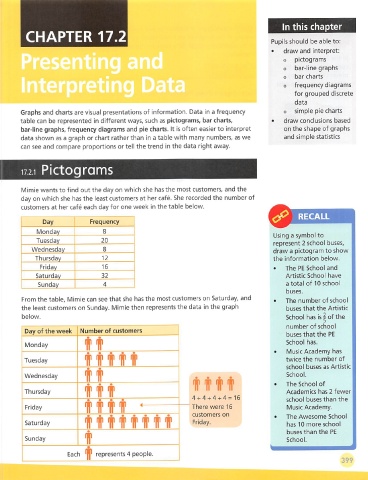
        Mimie wants to find out the day on which she has the most customers, and the
        day on which she has the least customers at her cafe. She recorded the number of
        customers at her cafe each day for one week in the table below.
                                                                                        ^ RECALL
               Day            Frequency
             Monday               S
                                                                                         Using a symbol to
             Tuesday              20
                                                                                         represent 2 school buses,
           Wednesday              8                                                      draw a pictogram to show
            Thursday              12                                                     the information below.
              Friday              16                                                     •     The RE School and
             Saturday             32                                                         Artistic School have
             Sunday               4                                                          a total of 10 school
                                                                                             buses.
        From the table, Mimie can see that she has the most customers on Saturday, and   •     The number of school
        the least customers on Sunday. Mimie then represents the data In the graph           buses that the Artistic
                                                                                                             the
                                                                                                           of
        below.                                                                               School has is |
                                                                                              number of school
         Day of the week   Number of customers
                                                                                              buses that the RE
         Monday             IT                                                               School has.
                                                                                         •     Music Academy has
                            f ttf i
         Tuesday                                                                             twice the number of
                                                                                             school buses as Artistic
         Wednesday          If                                                               School.
                                                              ("ifii                     •     The School of
         Thursday           tlHf                                                              Academics has 2 fewer
                                                               4 + 4 + 4 + 4 = 16
                                                                                             school buses than the
         Friday             Titir '                            There were 16                  Music Academy.
                                                               customers on
                                                                                         •      The Awesome School
         Saturday           titll'il'iHr'll'                   Friday.                        has 10 more school
                                                                                              buses than the RE
         Sunday             f                                                                 School.

                       Each     represents 4 people.
                                                                                                               399

