


Page 150 - Basic Principles of Textile Coloration
P. 150
WATER SOFTENING 139

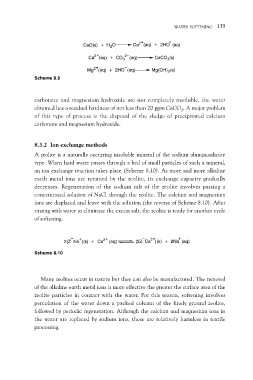
            CaO(s) + H2O                   Ca2 (aq) + 2HO (aq)

            Ca2 (aq) + CO32 (aq)           CaCO3(s)

            Mg2 (aq) + 2HO (aq)            Mg(OH)2(s)

Scheme 8.9

carbonate and magnesium hydroxide are not completely insoluble, the water
obtained has a residual hardness of not less than 20 ppm CaCO3. A major problem
of this type of process is the disposal of the sludge of precipitated calcium
carbonate and magnesium hydroxide.

8.3.2 Ion exchange methods

A zeolite is a naturally occurring insoluble mineral of the sodium aluminosilicate
type. When hard water passes through a bed of small particles of such a mineral,
an ion exchange reaction takes place (Scheme 8.10). As more and more alkaline
earth metal ions are retained by the zeolite, its exchange capacity gradually
decreases. Regeneration of the sodium salt of the zeolite involves passing a
concentrated solution of NaCl through the zeolite. The calcium and magnesium
ions are displaced and leave with the solution (the reverse of Scheme 8.10). After
rinsing with water to eliminate the excess salt, the zeolite is ready for another cycle
of softening.

                   2(Z Na )(s) + Ca2 (aq)  (2Z Ca2 )(s) + 2Na (aq)
Scheme 8.10

   Many zeolites occur in nature but they can also be manufactured. The removal
of the alkaline earth metal ions is more effective the greater the surface area of the
zeolite particles in contact with the water. For this reason, softening involves
percolation of the water down a packed column of the finely ground zeolite,
followed by periodic regeneration. Although the calcium and magnesium ions in
the water are replaced by sodium ions, these are relatively harmless in textile
processing.

