


Page 149 - Basic Principles of Textile Coloration
P. 149
138 WATER TREATMENT

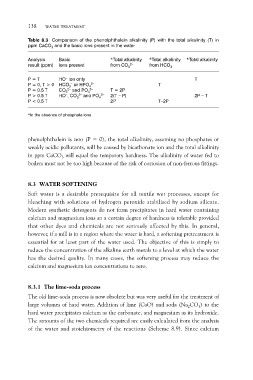
Table 8.3 Comparison of the phenolphthalein alkalinity (P) with the total alkalinity (T) in
ppm CaCO3 and the basic ions present in the water

Analysis      Basic                 *Total alkalinity *Total alkalinity *Total alkalinity

result (ppm) ions present           from CO32–  from HCO3

P=T           HO– ion only          T = 2P      T          T
P = 0, T > 0  HCO3– or HPO42–       2(T – P)    T–2P       2P – T
P = 0.5 T     CO32– and PO43–       2P
P > 0.5 T     HO–, CO32– and PO43–
P < 0.5 T

*In the absence of phosphate ions

phenolphthalein is zero (P = 0), the total alkalinity, assuming no phosphates or
weakly acidic pollutants, will be caused by bicarbonate ion and the total alkalinity
in ppm CaCO3 will equal the temporary hardness. The alkalinity of water fed to
boilers must not be too high because of the risk of corrosion of non-ferrous fittings.

8.3 WATER SOFTENING
Soft water is a desirable prerequisite for all textile wet processes, except for
bleaching with solutions of hydrogen peroxide stabilised by sodium silicate.
Modern synthetic detergents do not form precipitates in hard water containing
calcium and magnesium ions so a certain degree of hardness is tolerable provided
that other dyes and chemicals are not seriously affected by this. In general,
however, if a mill is in a region where the water is hard, a softening pretreatment is
essential for at least part of the water used. The objective of this is simply to
reduce the concentration of the alkaline earth metals to a level at which the water
has the desired quality. In many cases, the softening process may reduce the
calcium and magnesium ion concentrations to zero.

8.3.1 The lime-soda process
The old lime-soda process is now obsolete but was very useful for the treatment of
large volumes of hard water. Addition of lime (CaO) and soda (Na2CO3) to the
hard water precipitates calcium as the carbonate, and magnesium as its hydroxide.
The amounts of the two chemicals required are easily calculated from the analysis
of the water and stoichiometry of the reactions (Scheme 8.9). Since calcium

