


Page 120 - Lecture Notes DCC3113
P. 120
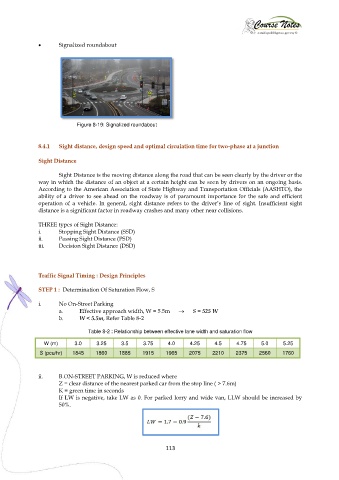
Signalized roundabout
Figure 8-19: Signalized roundabout
8.4.1 Sight distance, design speed and optimal circulation time for two-phase at a junction
Sight Distance
Sight Distance is the moving distance along the road that can be seen clearly by the driver or the
way in which the distance of an object at a certain height can be seen by drivers on an ongoing basis.
According to the American Association of State Highway and Transportation Officials (AASHTO), the
ability of a driver to see ahead on the roadway is of paramount importance for the safe and efficient
operation of a vehicle. In general, sight distance refers to the driver’s line of sight. Insufficient sight
distance is a significant factor in roadway crashes and many other near collisions.
THREE types of Sight Distance:
i. Stopping Sight Distance (SSD)
ii. Passing Sight Distance (PSD)
iii. Decision Sight Distance (DSD)
Traffic Signal Timing : Design Principles
STEP 1 : Determination Of Saturation Flow, S
i. No On-Street Parking
a. Effective approach width, W = 5.5m S = 525 W
b. W < 5.5m, Refer Table 8-2
Table 8-2 : Relationship between effective lane width and saturation flow
W (m) 3.0 3.25 3.5 3.75 4.0 4.25 4.5 4.75 5.0 5.25
S (pcu/hr) 1845 1860 1885 1915 1965 2075 2210 2375 2560 1760
ii. B.ON-STREET PARKING, W is reduced where
Z = clear distance of the nearest parked car from the stop line ( > 7.6m)
K = green time in seconds
If LW is negative, take LW as 0. For parked lorry and wide van, LLW should be increased by
50%.
113

