


Page 81 - Fisika Terapan for Engineers and Scientists
P. 81
9.3  Circular Orbits                          281


                                                        COMMUNICATIONS SATELLITES
                       PHYSICS IN PRACTICE
                                                        AND WEATHER SATELLITES


                                More than a hundred communications and weather
                        Concepts
                          in    satellites have been placed in geostationary orbits.
                        Context
                                The communications satellites use radio signals to
                                relay telephone and TV signals from one point on
                       the Earth to another. The weather satellites capture pictures
                       of the cloud patterns and measure the heights of clouds, wind
                       speeds, atmospheric and ground temperatures, and moisture
                       in the atmosphere. These observations are especially useful
                       for monitoring weather conditions over the oceans, where
                       there are few observation stations at ground level. Data col-
                       lected by weather satellites permit early detection of danger-
                       ous tropical storms (hurricanes, typhoons) and forecasting of
                       the tracks and the strengths of these storms.
                          The launch vehicle for these satellites usually consists of
                       a two-stage rocket, which carries the satellite to a low-altitude
                       orbit. A small rocket motor attached to the satellite is then
                       used to lift the satellite from the low-altitude orbit to the
                       high-altitude geostationary orbit. Alternatively, the satellite
                       can be ferried to the low-altitude orbit by the Space Shuttle.
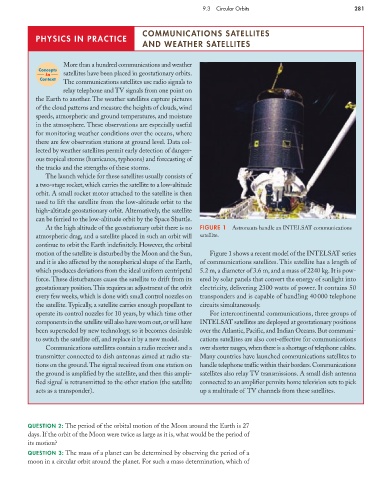
                          At the high altitude of the geostationary orbit there is no  FIGURE 1  Astronauts handle an INTELSAT communications
                       atmospheric drag, and a satellite placed in such an orbit will  satellite.
                       continue to orbit the Earth indefinitely. However, the orbital
                       motion of the satellite is disturbed by the Moon and the Sun,  Figure 1 shows a recent model of the INTELSAT series
                       and it is also affected by the nonspherical shape of the Earth,  of communications satellites. This satellite has a length of
                       which produces deviations from the ideal uniform centripetal  5.2 m, a diameter of 3.6 m, and a mass of 2240 kg. It is pow-
                       force. These disturbances cause the satellite to drift from its  ered by solar panels that convert the energy of sunlight into
                       geostationary position.This requires an adjustment of the orbit  electricity, delivering 2300 watts of power. It contains 50
                       every few weeks, which is done with small control nozzles on  transponders and is capable of handling 40 000 telephone
                       the satellite. Typically, a satellite carries enough propellant to  circuits simultaneously.
                       operate its control nozzles for 10 years, by which time other  For intercontinental communications, three groups of
                       components in the satellite will also have worn out,or will have  INTELSAT satellites are deployed at geostationary positions
                       been superseded by new technology, so it becomes desirable  over the Atlantic, Pacific, and Indian Oceans. But communi-
                       to switch the satellite off, and replace it by a new model.  cations satellites are also cost-effective for communications
                          Communications satellites contain a radio receiver and a  over shorter ranges,when there is a shortage of telephone cables.
                       transmitter connected to dish antennas aimed at radio sta-  Many countries have launched communications satellites to
                       tions on the ground.The signal received from one station on  handle telephone traffic within their borders.Communications
                       the ground is amplified by the satellite, and then this ampli-  satellites also relay TV transmissions. A small dish antenna
                       fied signal is retransmitted to the other station (the satellite  connected to an amplifier permits home television sets to pick
                       acts as a transponder).                           up a multitude of TV channels from these satellites.


                     QUESTION 2: The period of the orbital motion of the Moon around the Earth is 27
                     days. If the orbit of the Moon were twice as large as it is, what would be the period of
                     its motion?
                     QUESTION 3: The mass of a planet can be determined by observing the period of a
                     moon in a circular orbit around the planet. For such a mass determination, which of

