


Page 82 - Fisika Terapan for Engineers and Scientists
P. 82
282                                CHAPTER 9  Gravitation


                                                   the following do we need: the period, the radius of the moon’s orbit, the mass of the
                                                   moon, the radius of the planet?
                                                   QUESTION 4: The radius of the orbit of Saturn around the Sun is about 10 times the
                                                   radius of the orbit of the Earth. Accordingly, what must be the approximate period of
                                                   its orbital motion?
                                                      (A) 1000 yr    (B) 100 yr    (C) 30 yr    (D) 10 yr   (E) 3 yr


                  Online                           9.4 ELLIPTICAL ORBITS; KEPLER’S LAWS
                 12
                Concept
                 Tutorial                          Although the orbits of the planets around the Sun are approximately circular, none of
                                                   these orbits are exactly circular. We will not attempt the general solution of the equa-
                                                   tion of motion for such noncircular orbits. A complete calculation shows that with
                                                   the inverse-square force of Eq. (9.1), the planetary orbits are ellipses.This is Kepler’s
                                                   First Law:
                               Kepler’s First Law     The orbits of the planets are ellipses with the Sun at one focus.

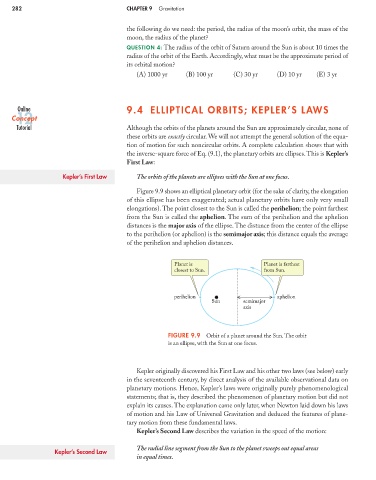
                                                      Figure 9.9 shows an elliptical planetary orbit (for the sake of clarity, the elongation
                                                   of this ellipse has been exaggerated; actual planetary orbits have only very small
                                                   elongations). The point closest to the Sun is called the perihelion; the point farthest
                                                   from the Sun is called the aphelion. The sum of the perihelion and the aphelion
                                                   distances is the major axis of the ellipse. The distance from the center of the ellipse
                                                   to the perihelion (or aphelion) is the semimajor axis; this distance equals the average
                                                   of the perihelion and aphelion distances.


                                                                 Planet is                  Planet is farthest
                                                                 closest to Sun.            from Sun.


                                                                 perihelion                      aphelion
                                                                             Sun      semimajor
                                                                                      axis


                                                               FIGURE 9.9  Orbit of a planet around the Sun. The orbit
                                                               is an ellipse, with the Sun at one focus.


                                                      Kepler originally discovered his First Law and his other two laws (see below) early
                                                   in the seventeenth century, by direct analysis of the available observational data on
                                                   planetary motions. Hence, Kepler’s laws were originally purely phenomenological
                                                   statements; that is, they described the phenomenon of planetary motion but did not
                                                   explain its causes. The explanation came only later, when Newton laid down his laws
                                                   of motion and his Law of Universal Gravitation and deduced the features of plane-
                                                   tary motion from these fundamental laws.
                                                      Kepler’s Second Law describes the variation in the speed of the motion:

                                                      The radial line segment from the Sun to the planet sweeps out equal areas
                             Kepler’s Second Law
                                                      in equal times.

