


Page 83 - Fisika Terapan for Engineers and Scientists
P. 83
9.4  Elliptical Orbits; Kepler’s Laws                   283


                       MATH HELP          ELLIPSES


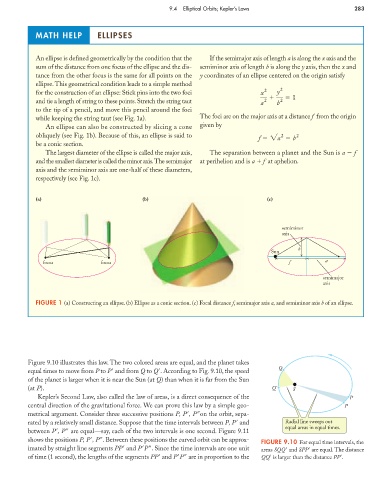
                       An ellipse is defined geometrically by the condition that the  If the semimajor axis of length a is along the x axis and the
                       sum of the distance from one focus of the ellipse and the dis-  semiminor axis of length b is along the y axis, then the x and
                       tance from the other focus is the same for all points on the  y coordinates of an ellipse centered on the origin satisfy
                       ellipse.This geometrical condition leads to a simple method
                       for the construction of an ellipse: Stick pins into the two foci    x 2  y 2
                                                                                                     1
                       and tie a length of string to these points. Stretch the string taut  a 2  b 2
                       to the tip of a pencil, and move this pencil around the foci
                       while keeping the string taut (see Fig. 1a).      The foci are on the major axis at a distance f from the origin
                          An ellipse can also be constructed by slicing a cone  given by
                       obliquely (see Fig. 1b). Because of this, an ellipse is said to            2   2
                                                                                           f   2a   b
                       be a conic section.
                          The largest diameter of the ellipse is called the major axis,  The separation between a planet and the Sun is a   f
                       and the smallest diameter is called the minor axis.The semimajor  at perihelion and is a   f at aphelion.
                       axis and the semiminor axis are one-half of these diameters,
                       respectively (see Fig. 1c).


                       (a)                              (b)                                  (c)


                                                                                                  semiminor
                                                                                                  axis

                                                                                                       b
                                                                                               Sun
                         focus             focus                                                    f          a

                                                                                                              semimajor
                                                                                                              axis

                       FIGURE 1 (a) Constructing an ellipse. (b) Ellipse as a conic section. (c) Focal distance f, semimajor axis a, and semiminor axis b of an ellipse.


                     Figure 9.10 illustrates this law. The two colored areas are equal, and the planet takes
                                                                                                 Q
                     equal times to move from P to P  and from Q to Q . According to Fig. 9.10, the speed
                     of the planet is larger when it is near the Sun (at Q) than when it is far from the Sun
                     (at P).                                                                   Q'    S
                        Kepler’s Second Law, also called the law of areas, is a direct consequence of the             P'
                     central direction of the gravitational force. We can prove this law by a simple geo-            P
                     metrical argument. Consider three successive positions P, P ,P  on the orbit, sepa-
                     rated by a relatively small distance. Suppose that the time intervals between P, P  and  Radial line sweeps out
                                                                                                   equal areas in equal times.
                     between P ,P   are equal—say, each of the two intervals is one second. Figure 9.11
                     shows the positions P, P ,P  . Between these positions the curved orbit can be approx-  FIGURE 9.10 For equal time intervals, the
                     imated by straight line segments PP  and P P  . Since the time intervals are one unit  areas SQQ  and SPP  are equal. The distance
                     of time (1 second), the lengths of the segments PP  and P P   are in proportion to the  QQ  is larger than the distance PP .

