


Page 26 - NAVAL SCIENCE 3 TEXTBOOK
P. 26
SEA  POWE R AN]) NAT IONA L SECURI TY   31


                                                               without them being used. This does not mean that strategists and
                                                               tacticians can eliminate these weapons from  their planning. To do
                                                               so would certainly be foolish if a potential adversary were known
                                                               to possess them. But it is at least conceivable that humankind will
                                                               take  the  necessary effort  to  prcvent  these and  other weapons of
                                                               mass destruction from being llsed in any future conflict.
                                                                  Another technical innovation that was used for the first time to
                                                               great tactical  advantage in Operation Desert Storm in  the Persian
                                                               Gulf \'Var  in  1991,  and  later  in  the  invasions  of Afghanistan  in
                                                               2001 and Iraq in 2003, is the "smart" weapon, such as laser-guided
                                                               bombs, rockets,  and programmable cruise  missiles.  These  highly
                                                               accurate  precision  weapons  have  greatly  increased  the  probabil-
                                                               ity of successful  target destruction with just a single shot or attack,
                                                               often  from  far  greater ranges than were  possible before. They are
                                                               more "surgical" in nature, and greatly reduce the possibility of col-
                                                               lateral damagc to innocent civilians and private property.
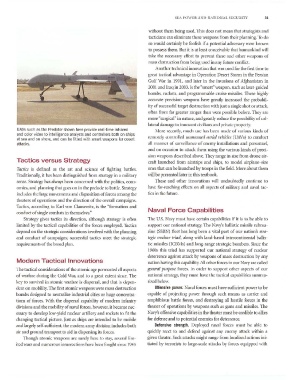
        UAVs such as the  Predator shown  here provide real -time infrared   1\·Jorc recently,  much  use  has been  made of various  kinds of
        and color video to  intelligence analysts and controllers both  on  ships
        at sea  and on shore,  and can  be  fitted with smart weapons for covert   remotel}' controlled  lllIl11(11/IICa aerial vehicles  (UAVs)  to  conduct
        attacks.                                               all  manner of surveillance of enemy instaUations and  personnel,
                                                               and on occasion to attack them  using the variolls kinds of preci-
                                                               sion weapons described above. The}' range in size from drone air-
        Tactics versus Strategy                                craft  launched  from  airstrips  and  ships,  to  model  airplane-size

        Tactics  is  defined  as  the  art  and  science  of  fighting  battles.   ones that can be launched by troops in the field.  j\·lore about them
        TraditionaU)"  it  has been distinguished from  strategy in  a military   will be presented later in this textbook.
        sense. Strategy has always been concerned with the politics, econ-  These  and  other  innovations  will  undoubtedly  continue  to
        omies, and planning that goes on in the prelude to battle. Strategy   have far-reaching effects on all  aspects of military and  naval  tac-
        includes the large movements and disposition of forces among the   tics in the future.
        theaters of operations and the direction of the overal1 campaigns.
        T..'lctics,  according to  Karl  von  C1ausewitz, is the "formation  and
                                                               Naval Force Capabilities
        conduct of single combats in themselves."
           Strategy gives  tactics  its  direction,  although  strategy is  often   The U.S.  Navy  must have certain capabilities  if it is to  be able to
        limited  by the tactical capabilities of the forces  employed. Tactics   . support our national strategy. The Navy's ballistic  missile subma-
        depend on the strategic considerations involved with the planning   rine  (SS13N)  fleet  has long been  a vital  part of our nation's stra-
        and  conduct of campaigns;  successful  tactics  meet  the  strategic   tegic  ,/lldenr triad,  along with  land-based  intercontinental  ballis-
        requirements of the broad plan.                        tic missiles (ICBMs)  and long-range strategic bombers. Since  the
                                                               1960s  this  triad  has  supported  our  national  strategy  of nuclear
                                                               deterrence against attack by weapons of mass  destruction  by any
        Modern Tactical Innovations                            nation having this capability. All other forces in our Navy are called

        The tactical considerations of the atomic age permeated all aspects   general purpose  forces.  In  order to support other aspects  of our
        of warfare during the Cold  \Var, and to a great extent since.  The   national strateg}', they must have  the tactical  capabilities summa-
        key to survival  in atomic warfare  is dispersal,  and that is depen-  rized below.
        dent on mobility. The first atomic weapons were mass destruction   Offensive  power. Naval forces  must have sufficient power to be
        bombs designed to neutralize industrial cities or huge concentra-  capable of projecting  power  through  such  means as  carrier and
        tions of forces. \Vith  the dispersal  capability of modern  infantr)'   amphibious battle forces. and destroying all  hostile  forces  in  the
        divisions and the mobility of naval forces, however, it became nec-  theater of operations by weapons such as  guns and missiles. The
        essary to develop low-yield nuclear artillery and rockets to fit  the   Navy's offensive capabilities in the theater must be credible to allies
        changing tactical  picture. Just as ships are  intended  to  be mobile   for defense and to potential enemies for deterrence.
        and largely self-sufficient, the modern army division includes both   Defensive  strenglh.  Deployed  naval  forces  llluSt  be  able  to
        air and ground transport to aid in dispersing its forces.   quickly  react  to  and  defend  against  any  enemy  attack  within  a
           Though  atomic  weapons arc surely here  to  stay,  several  lim-  given theater. Such attacks might range from localized actions ini-
        ited wars and numerous insurrections have been fought since 1945   tiated  by  terrorists to  large-scale  attacks by  forces  equipped with

