


Page 27 - NAVAL SCIENCE 3 TEXTBOOK
P. 27
32      NAVAL  KNOWI.EDGE


         both conventional  weapons such  as  guns or antiship  missiles,  or
         wcapons  of milSS  destruction.  Naval defensive  capabilities  must
         include long-range detection systems such ilS airborne early warn-
         ing,  quick-reacting command  and  control s}'stems,  and eftective
         defensive  weapons systems including  those designed  for  defense
         against ballistic and cruise missiles.
            Logistical  independence. Naval forces must be capable of sus-
         taining  themselves  for  extended  periods  of time,  and  for  much
         longer periods by underway replenishment by mobile logistic sup-
         ply  forces. Ships must be able  to  ride  out heavy  weather,  and  to
         steaIll  long  distances  without  refueling.  Overseas  bases  may  be
         helpful  for sustaining deployed forces during peacetime, but they
         l11a}' become a liabilit)1 in time of war.
            Command  and  control. The naval commander must be able to
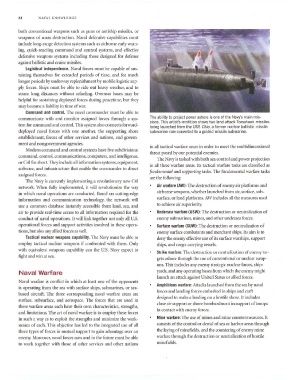
         communicate with  and  monitor assigned  forces  through  a  sys-  The ability to project power ashore is one of the Navy's main mis-
                                                                sions. This artist's rendition shows h."o land-attack Tomahawk missiles
         tem for command <Ind control. This system <lIsa connects forward-  being launched  from  the USS Ohio, a former nuclear ballistic missile
         deployed  naval  forces  with  one  another.  the  supporting  shore   submarine now converted to a guided missile submarine.
         establishment, forces  of other services  and  nations,  <Ind  govern-
         ment and nongovernment agencies.
                                                                in all  tactical  warfare ,\ll'.lS  in  order to meet the lllultidimensiol1nl
            Modern command and control systems have five subdivisions:
                                                                threat posed by our potential enemies.
         command. control, communications. computers, and intelligence.
                                                                   The Navy is tasked with both sea control and power projection
         or C41 for short. They include all information s)'stems, equipment,
                                                                in  all  three wart~lre areas.  Its tactical warfare tasks are classified  as
         software  •• 1Ild  infrastructure that enable the cOlllmander to direct
                                                                fil1lnfllllcllfnl and slipportillg tasks. The fundamental wa rfare  tasks
         assigned torces.
                                                                are the following:
            The Navy is currently implementing a revolutionary new C41
                                                                   Air warfare (AW): The destruction of enemy air platforms and
         network.  \"'hen  full)'  implemented. it will revolutionize  the  way
                                                                   airborne weapons. whether launched from air, surface, sub-
         in which  naval  opemtions are conducted. 13ased  on cutting-edge
                                                                   surface, or land platforms. A\'V includes all the measures used
         information  and  communication  technology,  the  network  will
                                                                   to achieve air superiority.
         use  a  comlllon  database  instantly accessible  from  land, sea,  and
         air to provide real-time access  to all  intormation required for  the   Undersea warfare (USW); The destruction or neutralization of
         conduct of naval operations.  It will link together not onl)' illl  u.S.   enelllY submarines, mines, and other undersea forces.
         operational  torces and support activities  involved  in  these opera-  Surface warfare (SUW): The destruction or neutralization of
         tions, but also an)' allied forces as well.               enem), surface combatants and merchant ships. Its ailll is to
            Tactical  nuclear weapons  capability. The Nilvy must be able to   dell)' the enemy effective use of its surface warships. support
         employ  tactical  nucleilr  we.lpons  if confronted  with  them. Only   ships. and cargo-carrying vessels.
         with  equivalent weapolls  capability  can  the  U.S.  Navy  expect  to
                                                                   Strike warfare: The destruction or neutralization of enelllY tar-
         fight and win at sen.
                                                                   gets ashore through the use of conventional or nuclear weap-
                                                                   ons. This includes any enelll)' strategic nuclear forces. ship-
         Naval Warfare                                             ynrds, and any opefilting bases from which the e11CI11)' might
                                                                   Inullch an attack ag.,inst United St;:ltes or allied fo rces.
         Naval  wMfare  is  conflict in  which  at least one of the opponents
                                                                   Amphibious warfare: Attacks laul1ched from the sea by naval
         is operating from  the sea with surf..1ce  ships,  submarines,  or sea-
                                                                   forces and landing forces embarked in ships nnd craft
         bnsed  aircraft. The  three  corresponding  nil\'.,1 wa rfa re  areas  are
                                                                   designed to make a landing on a hostile shore. It  includes
         surface.  subsurface, and  aerospace.  The  forces  thilt  are  used  in
                                                                   close 'lir support or shore bombardment in support of troops
         these  warfare areas ei.lCh  have  their own chamctcristics, strengths,
                                                                   in contact with el1cl11Y forces.
         and limitations. The art of naval warfare is to employ these forces
         in  such  a Wily as to exploit  the strengths and minimize the weak-  Mine warfare: The use of mines and mine countermeasures. It
         nesses of each. This objective  has led to  the integrated  use of all   consists of the control or denial of sea or harbor areas through
         three types of forces in  mutual support to gain advantage over an   the laying of minefields, and the countering of enemy mine
         enemy.  Moreover. naval forces now ilnd in the future I11l1St  be able   warfilre through the destruction or neutmlization of hostile
         to  work  together with  those of other services and  other nations   mineficlds.

