


Page 28 - NAVAL SCIENCE 3 TEXTBOOK
P. 28
SEA  POW ER AN D  NATIONAL SECURI T Y   33

            Information warfare (lW): Actions taken against an adversary's   produce timely warning of the location, composition, capabil-
            information or information systems. whUe defending our own   ities, and tactics of opposed forces.  National leaders and mili-
            information and information systems.                  taf)' commanders who correctly use interpreted intelligence
                                                                  are able to make decisions based on accurate knowledge of the
         The supporting warfare tilsks ilre the following:
                                                                  enemy's forces and capabilities.
            Special warfare: Naval operations that are unconventional
                                                                  Electronic warfare: The electronic support (or all warf.1re tasks.
            in nature, ilnd often clandestine in chilfi1cter. Special Wilr-
                                                                  Its primal1' objective is to ensure effective usc of the electro-
            J~lrC often accomplishes other fundamental wilrfiuc tilsks. but
                                                                  magnetic spectrum b)1 friendly forces, while determining,
           does so in a unique manner. Examples of special warfare are
                                                                  exploiting, reducing, or denying its lise b)1 an enelll)'.
            underwater demolition. special  mobile operations. coastal and
            river interdiction, beach alld coastal reconnaissance. and cer-  Logistics: The resllppl)1 of combat consumables to combat-
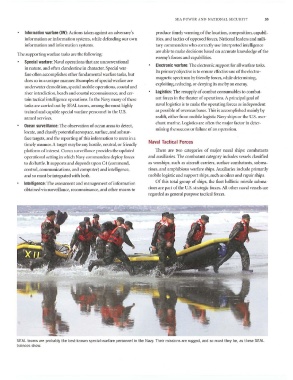
            til in tactical intelligence operations. In the Nilvy lllallY of these   ant forces in the theater of operations. A principal goal of
            tilsks arc carried Ollt by SEAL tC;'lI1lS, ilI1l0ng the Illost highly   naval logistics is to make the operating lorces as independent
            trained and cilpable special warf.1re personnel in the u.s.   as possible of overseas bases. This is accomplished mainly b)'
           armed services.                                        sealift, either fromlllobile logistic Nav)' ships or the u.s. mer-
                                                                  chant marine. Logistics are often the major factor in deter-
           Ocean surveillance: The observiltioll of oceall areilS to detect,
                                                                  mining the success or failure of an opemtion.
           locate, illld classi~1  potential aerospace, surf;1Cc, and subsur-
           face targets, ilnd the reporting of this information to llsers in a
                                                               Naval Tactical Forces
            timely manner. A target mily be any hostile, neutral, or friendl)'
            platform of interest. Ocean surveillance provides the updated   There  are  two  categories  of  major  naval ships:  combatants
           operational setting in which Navy cOlllmanders deploy forces   and alL':..iliaries. The combatant mtegol1' includes vessels classified
            to do battle. It supports and depends upon C4 (command.   as warships, such as <lirerati  carriers, surface combatants, subma-
           control, cOl1lmunications, and computer) and intelligence,   rines, and amphibious warfare ships. Auxiliaries include primarily
           and so Illust be integrated with both.              mobile logistic and support ships, stich as oilers and repair ships.
                                                                  Of this total group of ships.  the  neet bollistic missile subma-
           Intelligence: The assessment and management of informiltion
                                                               rines ilfC part of the U.S. strategic forces. All other naval vessels are
           obtained via surveillance, reconnnissance. and other means to
                                                               regarded as geneml purpose tactical forces.


        SEAL teams are probably the  best-known special-warfare personnel  in the Navy. Their missions are rugged, and so must they be,  as these SEAL
        trainees show.

