


Page 53 - JURNAL PENYELIDIKAN AKADEMIK
P. 53
J u r n a l   P e n y e l i d i k a n   I l m u   P e n d i d i k a n   I P G M   J i l i d   5 / 2 0 2 0  | 46


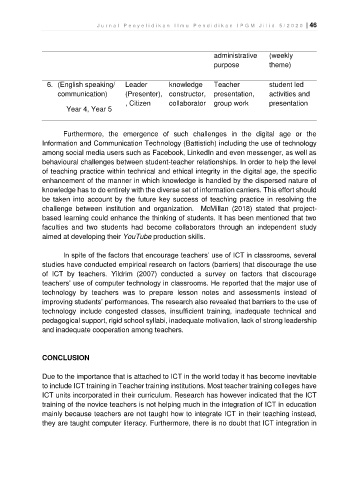
                                                                          administrative     (weekly
                                                                          purpose            theme)


                 6.  (English speaking/     Leader         knowledge      Teacher            student led
                     communication)         (Presenter),  constructor,  presentation,        activities and
                                            , Citizen      collaborator  group work          presentation
                        Year 4, Year 5


                       Furthermore,  the  emergence  of  such  challenges  in  the  digital  age  or  the
               Information and Communication Technology (Battistich) including the use of technology
               among social media users such as Facebook, LinkedIn and even messenger, as well as
               behavioural challenges between student-teacher relationships. In order to help the level
               of teaching practice within technical and ethical integrity in the digital age, the specific
               enhancement of the manner in which knowledge is handled by the dispersed nature of
               knowledge has to do entirely with the diverse set of information carriers. This effort should
               be taken into account by the future  key success of teaching practice in resolving the
               challenge  between  institution  and  organization.    McMillan  (2018)  stated  that  project-
               based learning could enhance the thinking of students. It has been mentioned that two
               faculties  and  two  students  had  become  collaborators  through  an  independent  study
               aimed at developing their YouTube production skills.

                       In spite of the factors that encourage teachers’ use of ICT in classrooms, several
               studies have conducted empirical research on factors (barriers) that discourage the use
               of  ICT  by  teachers.  Yildrim  (2007)  conducted  a  survey  on  factors  that  discourage
               teachers’ use of computer technology in classrooms. He reported that the major use of
               technology  by  teachers  was  to  prepare  lesson  notes  and  assessments  instead  of
               improving students’ performances. The research also revealed that barriers to the use of
               technology  include  congested  classes,  insufficient  training,  inadequate  technical  and
               pedagogical support, rigid school syllabi, inadequate motivation, lack of strong leadership
               and inadequate cooperation among teachers.


               CONCLUSION

               Due to the importance that is attached to ICT in the world today it has become inevitable
               to include ICT training in Teacher training institutions. Most teacher training colleges have
               ICT units incorporated in their curriculum. Research has however indicated that the ICT
               training of the novice teachers is not helping much in the integration of ICT in education
               mainly because teachers are not taught how to integrate ICT in their teaching instead,
               they are taught computer literacy. Furthermore, there is no doubt that ICT integration in

