


Page 368 - Hall et al (2015) Principles of Critical Care-McGraw-Hill
P. 368
238     PART 3: Cardiovascular Disorders


                 pulmonary vasoconstriction. In these circumstances, O  therapy and   Anaphylactic, Neurogenic, and Adrenal Shock:  Other etiologies of shock
                                                          2
                   pulmonary vasodilator therapy combine to decrease pulmonary hyper-  having unique clinical presentations that usually lead to early diagno-
                 tension and increase Q ˙ t in a small but significant proportion of patients   sis are anaphylactic shock and neurogenic shock. Beyond identifying
                 (see Chap. 38).                                       the etiology early through their association with triggering agents and
                   Right heart catheterization shows a unique hemodynamic profile:   trauma, respectively, the physician should note that the pathophysiol-
                 a very high mean pulmonary artery pressure, pulmonary arterial DP   ogy of each is a dilated venous bed with greatly increased unstressed
                 considerably greater than the Ppw and reduced Q ˙ t and SV. Not uncom-  volume of the circulation leading to hypovolemic shock. Accordingly,
                 monly, arterial Ppw is normal or increased despite a small LVEDV on   the mainstay of therapy for both conditions is adequate volume
                 echocardiographic examination, which also shows a right-to-left shift     infusion; adjunctive therapy for anaphylaxis includes antihistamines,
                 of the interventricular septum; presumably, this causes stiffening of the   steroids, and epinephrine to antagonize the mediators released in the
                 diastolic V-P curve of the left ventricle. A complication of pulmonary   anaphylactic reaction (see Chap.  128), whereas a careful search for
                 vasodilator therapy is hypotension due to systemic arterial dilation   sources of blood loss and hemorrhagic shock is part of the early resus-
                 unaccompanied by increased right heart output. Such effects aggravate   citation of spinal shock in the traumatized patient (see Chap. 119).
                 the hypoperfusion state, perhaps by reducing coronary blood flow   Not uncommonly, the presentation of patients with nonhemorrhagic
                 to the hypertrophied, dilated right ventricle. Some evidence suggests   hypovolemic shock raises the concern of acute adrenal cortical insuffi-
                 that shock associated with pulmonary hypertension is ameliorated by   ciency. When this possibility is not obviously excluded, it is appropriate
                 α-agonist therapy (eg, norepinephrine or phenylephrine), which acts as   to draw a serum cortisol level, provide adequate circulating steroids with
                 a predominant systemic arteriolar constrictor to increase BP sufficiently   dexamethasone, and conduct a corticotropin stimulation test to confirm
                 to maintain right ventricular perfusion. 59,60        or refute the diagnosis. Characteristically, hypotension and hypoperfu-
                   Right ventricular infarction causes low pulmonary artery pressures   sion in such patients will not respond to adequate vascular volume
                 and normal LV filling pressures because the dilated, injured right ven-  expansion until dexamethasone is administered (see Chap. 102).
                 tricle is unable to maintain adequate flow to the left heart.  Elevated
                                                             61
                 neck veins and Pra tend to decrease with dobutamine infusion, perhaps   Multiple Etiologies of Shock:  With this differential diagnosis and man-
                 because the enhanced contractility of the left ventricle improves systolic   agement evaluation in mind, the initial approach to patients with
                 function of the mechanically interdependent right ventricle.  Volume   hypoperfusion states should be completed in less time than it takes to
                                                             57
                 expansion often aggravates right ventricular dysfunction, and systemic   read about it. The target is to distinguish among patients with septic
                 vasoconstriction may preserve right ventricular perfusion. 62  shock,  cardiogenic  shock,  and  hypovolemic  shock  and  to  initiate  an
                   In the setting of severe AHRF, marked elevations of pulmonary   appropriate therapeutic challenge—antibiotics, inotropic agents, or a
                   vascular resistance can be induced by hypoxic  vasoconstriction. 63-65    volume challenge—within 30 minutes of presentation. By the response,
                 This hypoxic pulmonary vasoconstriction appears to be stimulated by   the diagnosis is confirmed or challenged, with special regard to equivo-
                 mixed venous hypoxemia.  In most patients with ARDS, this explains   cal responses to therapy or to several other diagnostic categories of
                                    66
                                                 increase. In a subset of these   shock. Sorting out the primary etiology of the hypoperfusion state
                 the increase in Q ˙ s/Q ˙ t when CO and Pv O 2        often requires considerable additional data. This process is rendered
                 patients, RV dysfunction with dilatation of the RV and bowing of the
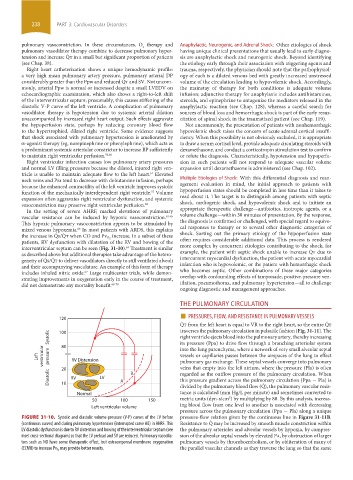
                 interventricular septum can be seen (Fig. 31-10).  Treatment is similar   more complex by concurrent etiologies contributing to the shock, for
                                                     63
                 as described above but additional therapies take advantage of the hetero-  example, the patient with septic shock unable to increase Q ˙ t due to
                 geneity of Q ˙ s/Q ˙ t to deliver vasodilators directly to still ventilated alveoli   intercurrent myocardial dysfunction, the patient with acute myocardial
                 and their accompanying vasculature. An example of this form of therapy   infarction who is hypovolemic, or the patient with hemorrhagic shock
                 includes inhaled nitric oxide.  Large multicenter trials, while demon-  who becomes septic. Other combinations of these major categories
                                       67
                 strating improvements in oxygenation early in the course of treatment,   overlap with confounding effects of tamponade, positive-pressure ven-
                 did not demonstrate any mortality benefit. 68-70      tilation, pneumothorax, and pulmonary hypertension—all to challenge
                                                                       ongoing diagnostic and management approaches.
                                                                       THE PULMONARY CIRCULATION
                                                                           ■

                              120                                         PRESSURES, FLOW, AND RESISTANCE IN PULMONARY VESSELS
                                                                       Q ˙ t from the left heart is equal to VR to the right heart, so the entire Q ˙ t
                                                                       traverses the pulmonary circulation in pulsatile fashion (Fig. 31-11). The
                          Systolic  100                                right ventricle ejects blood into the pulmonary artery, thereby increasing
                                                                       its pressure (Ppa) to drive flow through a branching arteriolar system
                               80
                       Left   ventricular  pressure  RV Distension     into the lung parenchyma, where a network of very small alveolar septal
                                                                       vessels or capillaries passes between the airspaces of the lung to effect
                                                                       pulmonary gas exchange. These septal vessels converge into pulmonary
                                                                       veins that empty into the left atrium, where the pressure (Pla) is often
                          Diastolic  20  RV  LV    A  B                regarded as the outflow pressure of the pulmonary circulation. When
                                                                       this pressure gradient across the pulmonary circulation (Ppa − Pla) is
                               10
                                                                       tance is calculated (mm Hg/L per minute) and sometimes converted to
                                    Normal                             divided by the pulmonary blood flow (Q ˙ ), the pulmonary vascular resis-
                                                                                        5
                                         50        100      150        metric units (dyn-s/cm ) by multiplying by 80. By this analysis, increas-
                                         Left ventricular volume       ing blood flow from one level to another is associated with decreasing
                                                                       pressure across the pulmonary circulation (Ppa − Pla) along a unique
                 FIGURE 31-10.  Systolic and diastolic volume-pressure (V-P) curves of the LV before   pressure-flow relation given by the continuous line in Figure 31-11B.
                 (continuous curves) and during pulmonary hypertension (interrupted curve AB) in AHRF. This   Resistance to Q ˙  may be increased by smooth muscle constriction within
                 LV diastolic dysfunction is due to RV distention and bowing of the interventricular septum (see   the pulmonary arterioles and alveolar vessels by hypoxia, by compres-
                 inset cross-sectional diagram) so that the LV preload and SV are reduced. Pulmonary vasodila-  sion of the alveolar septal vessels by elevated Pa, by obstruction of larger
                 tors such as NO have some therapeutic effect, but extracorporeal membrane oxygenation   pulmonary vessels by thromboembolism, or by obliteration of many of
                               may provide better results.             the parallel vascular channels as they traverse the lung so that the same
                 (ECMO) to increase Pv O 2


            section03.indd   238                                                                                       1/23/2015   2:06:44 PM

