


Page 369 - Hall et al (2015) Principles of Critical Care-McGraw-Hill
P. 369
CHAPTER 31: The Pathophysiology of the Circulation in Critical Illness  239


                          A                                                The pulmonary artery and the left atrium are surrounded by Ppl, so
                                                          Thorax          absolute values of Ppa and Pla change with respiration. When spontane-
                                              PA                          ous active inspiration decreases Ppl, pulmonary arterial and left atrial
                           Catheter  Ppl                                  pressures decrease, but the driving pressure of blood flow across the lung
                                                                          stays the same (Ppa − Pla); when positive-pressure inflation increases
                                  Ppa                   Pla               Ppl, Ppa and Pla increase. Accordingly, it is helpful to record pulmonary
                                                                          vascular measurements at end expiration when the mode of ventilation
                                                                          has minimally different effects; even this approach can be confounded
                                              PA
                                                                          when the patient exerts vigorous respiratory activity. When alveolar
                                                                          pressure (Pa) exceeds Pla, the true driving pressure for pulmonary blood
                                                                          flow is Ppa − Pa. One often overlooked adverse effect of positive-pressure
                                                                          ventilation with high PEEP or high tidal volume is the large increase in
                          B
                                                                          dead space (V /V ) when pulmonary blood flow is interrupted by the
                                                                                      t
                                                                                    d
                                                                          high Pa; not infrequently, alveolar ventilation can actually increase when
                                                                          tidal volume is reduced in these conditions, causing a paradoxical fall in
                                                                             . A second consequence of Pa being greater than Pla is an overesti-
                                                                          Pa CO 2
                                                                          mation of Ppw; this can be detected when the respiratory fluctuation in
                                                                          Ppa is much less than that in Ppw.  Given these effects of respiration on
                                                                                                  71
                                   Q
                                  .
                                                                          measurements of Ppa and Ppw, it is not surprising that many physicians
                                                                          err in their interpretation of PAC data. 72,73  Further, PAC use is accom-
                                            A
                                                                          panied by complications, and it can be argued that the hemodynamic
                                                          .               data obtained can be deduced by clinical examination, are not helpful
                                              PVR = (Ppa − Pla)/Q
                                                                          in clinical decision making, or do not improve outcome. 74-76  However,
                                                                          physicians also err in their clinical evaluations, 77,78  so it seems reasonable
                                               Ppa – Pla                  to encourage multiple tools to assess the circulation, including echocar-
                                                                          diographic imaging, dynamic assessments (eg, PP variation, right atrial
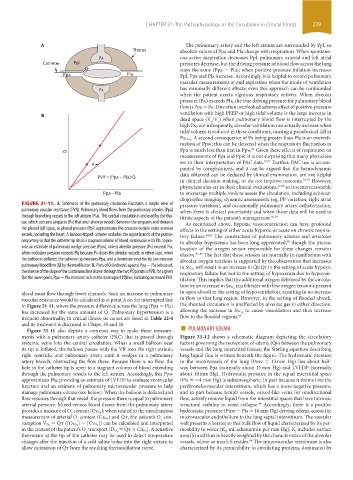
                    FIGURE 31-11.  A. Schematic of the pulmonary circulation illustrates a simple view of   pressure variation), and occasionally pulmonary artery catheterization,
                    pulmonary vascular resistance (PVR). Pulmonary blood flows from the pulmonary arteries (Ppa)   when there is clinical uncertainty and when those data will be used to
                    through branching vessels to the left atrium (Pla). This central circulation is enclosed by the tho-  titrate aspects of the patient’s management. 56,79
                    rax, which contains airspaces (Pa) that abut alveolar vessels. Between the airspaces and thorax is   As mentioned above,  hypoxic  vasoconstriction  can have  profound
                    the pleural (pl) space, so pleural pressure (Ppl) approximates the pressure outside extra-alveolar   effects in the setting of either acute hypoxic or acute on chronic respira-
                    vessels, including the heart. A balloon-tipped catheter occludes the upper branch of the pulmo-  tory failure. 64,65  The constriction of pulmonary  arteries  and arterioles
                    nary artery so that the catheter tip sits in a stagnant column of blood, continuous with Pla, to pro-  to alveolar hypoxemia has been long appreciated,  though the precise
                                                                                                              80
                    vide an estimate of pulmonary wedge pressure (Ppw), unless alveolar pressure (Pa) exceeds Pla,   location of the oxygen sensor responsible for these changes remains
                    when occlusion pressure exceeds Pla because Pa closes the alveolar vessels; in either case, when   elusive. 81-83  The fact that these sensors are normally in equilibrium with
                    the balloon is deflated, the catheter tip measures Ppa, and a thermistor near the tip can measure   alveolar oxygen tensions is supported by the observation that increases
                    pulmonary blood flow (Q) by thermodilution. B. Plots of Q (ordinate) against Ppa − Pla (abscissa);    will result in an increase in Q ˙ s/Q ˙ t in the setting of acute hypoxic
                                                 ˙
                                ˙
                    the inverse of the slope of the continuous line drawn through the two PQ points is PVR; for a given   in Sv O 2
                                                         ˙
                                                                          respiratory failure but not in the setting of hypoxemia due to hypoven-
                    ˙
                    Q at the lower point, Ppa − Pla increases to A on the interrupted PQ line, indicating increased PVR.  tilation. This implies that the additional oxygen delivered by the circula-
                                                       ˙
                                                                                             equilibrates with low oxygen tensions present
                                                                          tion by an increase in Sv O 2
                    blood must flow through fewer channels. Such an increase in pulmonary   in open alveoli in the setting of hypoventilation, resulting in no increase
                    vascular resistance would be calculated as at point A on the interrupted line   in flow to that lung region. However, in the setting of flooded alveoli,
                    in Figure 31-11, where the pressure difference across the lung (Ppa − Pla)     the shunted circulation is unaffected by alveolar gas in either direction,
                    has increased for the same amount of Q ˙  . Pulmonary hypertension is a   allowing  the  increase  in  Sv O 2   to  cause  vasodilation  and  thus  increase
                      frequent abnormality in critical illness; its causes are listed in Table 22-4   flow to the flooded regions. 66
                     Figure 31-11 also depicts a common way to make these measure-  ■
                    and its treatment is discussed in Chaps. 35 and 38.     PULMONARY EDEMA
                    ments with a pulmonary artery catheter (PAC) that is passed through   Figure 31-12 shows a schematic diagram depicting the circulatory
                    systemic veins into the central circulation. When a small balloon near   factors governing the movement of edema (Q ˙ e) between the pulmonary
                    its tip is inflated, the balloon passes with the VR into the right atrium,   vessels and the lung interstitial tissues; the Starling equation describing
                    right ventricle, and pulmonary artery until it wedges in a pulmonary   lung liquid flux is written beneath the figure. The hydrostatic pressure
                    artery branch, obstructing the flow there. Because there is no flow, the   in the microvessels of the lung (Pmv  = 12 mm Hg) lies about half-
                    hole in the catheter tip is open to a stagnant column of blood extending   way between Ppa (normally about 15 mm Hg) and LVEDP (normally
                    through the pulmonary vessels to the left atrium. Accordingly, this Ppw   about 10 mm Hg). Hydrostatic pressure in the septal interstitial space
                    approximates Pla, providing an estimate of LVEDP to evaluate ventricular   (Pis = −4 mm Hg) is subatmospheric, in part because it drains into the
                    function and an estimate of pulmonary microvascular pressure to help   peribronchovascular interstitium, which has a more negative pressure,
                    manage pulmonary edema (see below). When the balloon is deflated and   and in part because lymph vessels, valved-like veins for unidirectional
                    flow resumes through that vessel, the pressure there is equal to pulmonary   flow, actively remove liquid from the interstitial spaces that have intrinsic
                    arterial pressure. Mixed venous blood drawn from the pulmonary artery   structural stability to resist collapse.  Accordingly, there is a positive
                                                                                                    84
                                               ); when related to the simultaneous   hydrostatic pressure (Pmv − Pis = 16 mm Hg) driving edema across the
                    provides a measure of O  content (Cv O 2
                                    2
                                       2                           2
                    measurement of arterial O  content (Ca O 2 ) and Q ˙ t, the patient’s O  con-  microvascular endothelium to the lung septal interstitium. The vascular
                            O 2
                    sumption V ˙  = Q ˙ t ([Cv O 2 ] − [Cv O 2 ]) can be calculated and interpreted   wall presents a barrier to this bulk flow of liquid characterized by its per-
                                                              ). A sensitive   meability to water (K ; mL edema/min per mm Hg); K  includes surface
                                         2
                    in the context of the patient’s O  transport (D O 2  = Q ˙ t × Ca O 2  f                     f
                    thermistor at the tip of the catheter may be used to detect temperature   area (S) and thus is heavily weighted by the characteristics of the alveolar
                    changes after the injection of a cold saline bolus into the right atrium to   vessels, where so much S resides.  The microvascular membrane is also
                                                                                                 84
                    allow estimation of Q ˙ t from the resulting thermodilution curve.  characterized by its permeability to circulating proteins, dominated by
            section03.indd   239                                                                                       1/23/2015   2:06:45 PM

