


Page 418 - Hall et al (2015) Principles of Critical Care-McGraw-Hill
P. 418
288     PART 3: Cardiovascular Disorders


                 cardioversion,  for example,  50 J,  whereas  higher  energies  may  be   Catheter ablation for cure of atrial flutter is an effective therapy.
                                                                                                                          54
                 required for atrial fibrillation (≥120 J for biphasic). Since the incor-  Atrial fibrillation ablation/pulmonary vein isolation can be considered
                 poration of biphasic waveforms into external defibrillators, it is rare   for long-term cure of AF in selected patients.  AV junction ablation and
                                                                                                       55
                 for cardioversion to fail to convert recent onset AF. Atrial flutter may   ventricular pacing is an effective option in patients in whom effective
                 be terminated by rapid atrial overdrive pacing. Some dual chamber   ventricular rate control of AF cannot be achieved pharmacologically
                 pacemakers and implantable defibrillators have atrial antitachycardia   (please note these patients still require anticoagulation since their atria
                 pacing therapies for pace termination of atrial flutter.  are still in fibrillation). 44,54
                   If  AF/flutter  has  persisted  for  ≥48  hours  in  the  absence  of  effective   The patient with AF or atrial flutter is at risk of thromboembolism
                 anticoagulation, therapy should be aimed at achieving ventricular rate   particularly if the patient is older or has structural heart disease.  The
                                                                                                                      40
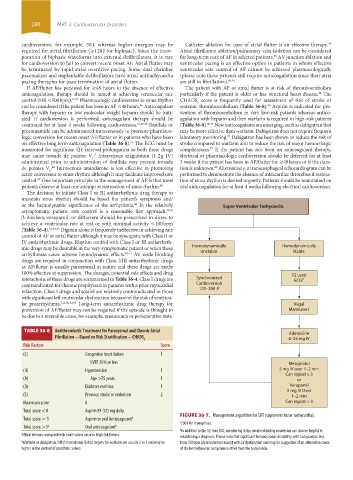
                 control (HR <100 bpm). 44,45  Pharmacologic cardioversion to sinus rhythm   CHADS  score is frequently used for assessment of risk of stroke or
                                                                             2
                 can be considered if the patient has been in AF <48 hours.  Anticoagulant   systemic thromboembolism (Table 36-8).  Aspirin is indicated for pre-
                                                                                                     46
                                                          46
                 therapy with heparin or low molecular weight heparin should be  initi-  vention of thromboembolism in very low-risk patients whereas antico-
                 ated. If cardioversion is performed, anticoagulant therapy should be   agulation with heparin and then warfarin is required in high-risk patients
                 continued for at least 4 weeks following cardioversion. 16,40,46  Ibutilide or   (Table 36-8). 40,56  New anticoagulants are emerging, such as dabigatran that
                 procainamide can be administered intravenously to promote pharmaco-  may be more effective than warfarin. Dabigatran does not require frequent
                 logic conversion for recent onset AF/flutter or in patients who have been   laboratory monitoring.  Dabigatran has been shown to reduce the risk of
                                                                                       57
                 on effective long term anticoagulation (Table 36-8).  The ECG must be   stroke compared to warfarin and to reduce the risk of major hemorrhagic
                                                      16
                 monitored for significant Q ˙ t interval prolongation as both these drugs   complications.   If the  patient has  not been on  anticoagulant therapy,
                                                                                 57
                 may  cause  torsade  de  pointes  V .   Intravenous  magnesium  (1-2 g  IV)   electrical or pharmacologic cardioversion should be deferred for at least
                                          7
                                         t
                 administered prior to administration of ibutilide may prevent torsade   3 weeks if the patient has been in AF/flutter for ≥48 hours or if the dura-
                 de pointes V .  Intravenous amiodarone is less effective in promoting   tion is unknown.  Alternatively, a transesophageal echocardiogram can be
                            44
                                                                                   46
                           t
                 acute conversion to sinus rhythm although it may facilitate improved rate   performed to demonstrate the absence of intracardiac thrombus if restora-
                 control.  One important principle in the management of AF is that most   tion of sinus rhythm is desired urgently. Patients should be maintained on
                       47
                 patients deserve at least one attempt at restoration of sinus rhythm. 40  oral anticoagulation for at least 4 weeks following electrical cardioversion.
                   The decision to initiate Class I or III antiarrhythmic drug therapy to
                 maintain sinus rhythm should be based the patient’s symptoms and/
                 or  the  hemodynamic significance of the arrhythmia.  In the relatively   Super Ventricular Tachycardia
                                                        44
                 asymptomatic patient, rate control is a reasonable first approach. 48,49
                 β-Blockers,  verapamil, or diltiazem should be prescribed in doses to
                 achieve  a  ventricular rate at rest or with minimal activity  <100 bpm
                 (Table 36-4). 16,44,45  Digoxin alone is frequently ineffective in achieving rate
                 control of AF or atrial flutter although it may be synergistic with Class II or
                 IV antiarrhythmic drugs. Rhythm control with Class I or III antiarrhyth-
                 mic drugs may be desirable in the very symptomatic patient or when these   Hemodynamically  Hemodynamically
                 arrhythmias cause adverse hemodynamic effects. 48-51  AV node blocking   Unstable            Stable
                 drugs are required in conjunction with Class I/III antiarrhythmic drugs
                 as AF/flutter is usually paroxysmal in nature and these drugs are rarely
                 100% effective at suppression. The dosages, potential side effects and drug                 12 Lead
                 interactions of these drugs are summarized in Table 36-4. Class I drugs are   Synchronized   ECG b
                 contraindicated for chronic prophylaxis in patients with a prior myocardial   Cardioversion
                                                                                    a
                 infarction. Class I drugs and sotalol are relatively contraindicated in those   120–200 J
                 with significant left ventricular dysfunction because of the risk of ventricu-
                 lar   proarrhythmia. 7,11,40,52,53  Long-term antiarrhythmic drug therapy for                Vagal
                 prevention of AF/flutter may not be required if the episode is thought to                  Maneuvers
                 be due to a reversible cause, for example, pneumonia or perioperative state.
                   TABLE 36-8     Antithrombotic Treatment for Paroxysmal and Chronic Atrial                Adenosine
                             Fibrillation—Based on Risk Stratification—CHADS
                                                           2                                                6–24 mg IV
                  Risk Factors                                   Score
                  (C)                  Congestive heart failure  1
                                         LVEF 35% or less                                                   Metoprolol
                  (H)                  Hypertension              1                                       5 mg IV over 1–2 min
                                                                                                           Can repeat × 3
                  (A)                    Age >75 years           1                                             or
                  (D)                  Diabetes mellitus         1                                           Verapamil
                                                                                                            5 mg IV Over
                  (S)                  Previous stroke or embolism  2                                        1–2 min
                  Maximum score        6                                                                   Can repeat × 3
                  Total score <0       Aspirin 81-325 mg daily
                                                                       FIGURE 36-7.  Management algorithm for SVT (supraventricular tachycardia).
                  Total score = 1      Aspirin or oral Anticoagulant b
                                                                       a 200 J for monophasic.
                  Total score >1 a     Oral anticoagulant b
                                                                       b In addition to the 12-lead ECG, monitoring strips obtained during conversion can also be  helpful in
                 a Mitral stenosis and prosthetic heart valves are also high risk factors.  establishing a diagnosis. Please note that significant hemodynamic instability with tachycardias less
                 b Warfarin or dabigatran. INR (International Ratio) targets for warfarin are usually 2 to 3 and may be   than 150 bpm are uncommon except with LV dysfunction and may be suggestive of an alternative cause
                 higher in the context of prosthetic valves.           of the hemodynamic compromise other than the tachycardia.


            section03.indd   288                                                                                       1/23/2015   2:07:14 PM

