


Page 415 - Hall et al (2015) Principles of Critical Care-McGraw-Hill
P. 415
CHAPTER 36: Cardiac Arrhythmias, Pacing, Cardioversion, and Defibrillation in the Critical Care Setting  285


                    Synchronized cardioversion with 120 to 200 J biphasic shock (depending     therapy. 33-35  In patients with less severe left ventricular dysfunction, ami-
                    on manufacturer’s recommendation) or 360 J monophasic shock is the   odarone appears to be as efficacious as the ICD and long-term therapy
                    initial approach for the patient with hemodynamically unstable V . If the   with amiodarone or an ICD may be individualized. 35
                                                                  t
                    patient is hemodynamically stable and has normal or only mild left ven-
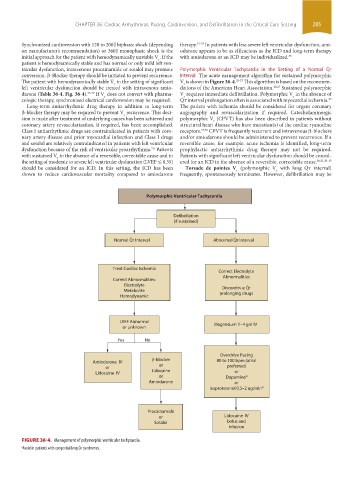
                    tricular dysfunction, intravenous procainamide or sotalol may promote   Polymorphic Ventricular Tachycardia in the Setting of a Normal  Q ˙ t
                    conversion. β-Blocker therapy should be initiated to prevent recurrence.   Interval:  The acute management algorithm for sustained polymorphic
                    The patient with hemodynamically stable V  in the setting of significant   V  is shown in Figure 36-4. 25-27  This algorithm is based on the recommen-
                                                                           t
                                                   t
                    left ventricular dysfunction should be treated with intravenous amio-  dations of the American Heart Association. 26,27  Sustained polymorphic
                    darone (Table 36-4, Fig. 36-4). 25-27  If V  does not convert with pharma-  V  requires immediate defibrillation. Polymorphic V  in the absence of
                                                                           t
                                                t
                                                                                                                t
                    cologic therapy, synchronized  electrical cardioversion may be required.  Q ˙ t interval prolongation often is associated with myocardial ischemia.
                                                                                                                            23
                     Long-term antiarrhythmic drug therapy in addition to long-term   The patient with ischemia should be considered for urgent coronary
                    β-blocker therapy may be required to prevent V  recurrence. This deci-  angiography and revascularization if required. Catecholaminergic
                                                      t
                    sion is made after treatment of underlying causes has been achieved and   polymorphic V  (CPVT) has also been described in patients without
                                                                                     t
                    coronary artery revascularization, if required, has been accomplished.   structural heart disease who have mutation(s) of the cardiac ryanodine
                    Class I antiarrhythmic drugs are contraindicated in patients with coro-  receptors. 24,36  CPVT is frequently recurrent and intravenous β-blockers
                    nary artery disease and prior myocardial infarction and Class I drugs   and/or amiodarone should be administered to prevent recurrence. If a
                    and sotalol are relatively contraindicated in patients with left ventricular   reversible cause, for example, acute ischemia is identified, long-term
                    dysfunction because of the risk of ventricular proarrhythmia.  Patients   prophylactic antiarrhythmic drug therapy may not be required.
                                                                7,8
                    with sustained V  in the absence of a reversible, correctable cause and in    Patients with significant left ventricular dysfunction should be consid-
                                t
                    the setting of moderate to severe left ventricular dysfunction (LVEF ≤ 0.35)     ered for an ICD in the absence of a reversible, correctable cause. 30,31,33-35
                    should  be  considered  for  an  ICD.  In  this  setting,  the  ICD  has  been   Torsade de pointes V  (polymorphic  V  with  long Q ˙ t interval)
                                                                                             t
                                                                                                          t
                    shown to reduce cardiovascular mortality compared to amiodarone   frequently,  spontaneously  terminates.  However,  defibrillation  may  be
                                                              Polymorphic Ventricular Tachycardia
                                                                       Defibrillation
                                                                       (if sustained)


                                                   Normal QT Interval                Abnormal QT Interval


                                                   Treat Cardiac Ischemia
                                                                                       Correct Electrolyte
                                                                                        Abnormalities
                                                   Correct Abnormalities:
                                                       Electrolyte
                                                                                        Discontinue QT
                                                      Metabolite                       prolonging drugs
                                                     Hemodynamic


                                                     LVEF Abnormal                   Magnesium 1–4 gm IV
                                                      or unknown
                                                    Yes       No


                                                                                       Overdrive Pacing
                                                                β-blocker
                                            Amiodarone  IV                            80 to 100 bpm (atrial
                                                or                or                      preferred)
                                             Lidocaine  IV      Lidocaine                   or
                                                                  or                     Dopamine a
                                                               Amiodarone                   or
                                                                                    Isoproterenol 0.5–2 ug/min a


                                                               Procainamide
                                                                  or                     Lidocaine  IV
                                                                 Sotalol                  bolus and
                                                                                          infusion

                    FIGURE 36-4.  Management of polymorphic ventricular tachycardia.
                    a Avoid in patients with congenital long Q t syndromes.
                                       ˙


            section03.indd   285                                                                                       1/23/2015   2:07:11 PM

