


Page 417 - Hall et al (2015) Principles of Critical Care-McGraw-Hill
P. 417
CHAPTER 36: Cardiac Arrhythmias, Pacing, Cardioversion, and Defibrillation in the Critical Care Setting  287


                    preexcitation is not manifest on the ECG and retrograde conduction via   function. In some instances, a transesophageal echocardiogram may be
                    the accessory connection is concealed. True atrial tachycardia is most   required to assess valve function or to determine if an intracardiac throm-
                    commonly due to enhanced or abnormal atrial automaticity or triggered   bus is present (usually for atrial fibrillation or flutter). Cardiac hemody-
                    activity. P waves usually precede each QRS complex unless there is AV   namic data during the arrhythmia, if available, should be reviewed.
                    conduction block. Multifocal atrial tachycardia is characterized by varia-
                    tion in P-wave morphology on a beat-to-beat basis.        ■  MANAGEMENT OF SUPRAVENTRICULAR TACHYARRHYTHMIAS
                        ■  EVALUATION OF THE PATIENT WITH SUPRAVENTRICULAR    General Principles of Treatment:  Sinus  rhythm  should  be  restored  as
                                                                          soon as possible if the patient is symptomatic. In the case of AF, therapy
                      TACHYARRHYTHMIA                                     aimed at controlling the ventricular rate is usually the initial approach.
                    The initial evaluation of the patient with a sustained supraventricular   Any reversible causes should be identified and corrected. Underlying
                                                                          structural heart disease should be treated—particularly the manage-
                    tachyarrhythmia  should  include  a  thorough  history  (if  patient  able  to   ment of ischemic heart disease, left ventricular dysfunction, and/or
                    communicate) and physical examination with special attention to detect-  hypertension should be optimized. The probability of recurrence and
                    ing structural heart disease.  A 12-lead ECG of the arrhythmia as well   the need for chronic prophylactic therapy should be determined.
                                        16
                    as during sinus rhythm should be obtained. Rhythm strips  documenting
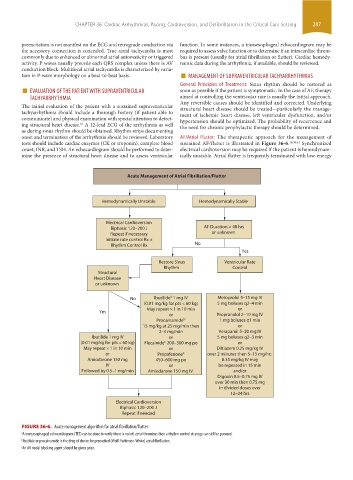
                    onset and termination of the arrhythmia should be reviewed. Laboratory   AF/Atrial Flutter:  The therapeutic approach for the management of
                    tests should include cardiac enzymes (CK or troponin), complete blood   sustained AF/flutter is illustrated in Figure 36-6. 16,40,44  Synchronized
                    count, INR, and TSH. An echocardiogram should be performed to deter-  electrical cardioversion may be required if the patient is hemodynam-
                    mine the presence of structural heart disease and to assess ventricular   ically unstable. Atrial flutter is frequently terminated with low-energy


                                                        Acute Management of Atrial Fibrillation/Flutter


                                               Hemodynamically Unstable         Hemodynamically Stable


                                                Electrical Cardioversion
                                                  Biphasic 120–200 J              AF Duration > 48 hrs
                                                  Repeat if necessary               or unknown
                                                Initiate rate control Rx ±
                                                  Rhythm Control Rx            No
                                                                                               Yes
                                                                  Restore Sinus          Ventricular Rate
                                                                    Rhythm                 Control
                                              Structural
                                            Heart Disease
                                             or unknown

                                                                      a
                                                         No      Ibutilide  1 mg IV   Metoprolol 5–15 mg IV
                                                             (0.01 mg/kg for pts < 60 kg)  5 mg boluses q2–4 min
                                                              May repeat × 1 in 10 min       or
                                              Yes
                                                                      or              Propranolol 2–10 mg IV
                                                                  Procainamide b       1 mg boluses q1 min
                                                             15 mg/kg at 25 mg/min then      or
                                                                  2–4 mg/min           Verapamil 5–20 mg IV
                                           Ibutilide 1 mg IV          or              5 mg boluses q2–3 min
                                                                    c
                                        (0.01 mg/kg for pts < 60 kg)  Flecainide  200–300 mg po  or
                                         May repeat × 1 in 10 min     or              Diltiazem 0.25 mg/kg IV
                                                or                Propafenone c    over 2 minutes then 5–15 mg/hr;
                                          Amiodarone 150 mg      450–600 mg po          0.35 mg/kg IV may
                                                IV                    or               be repeated in 15 min
                                        Followed by 0.5–1 mg/min  Amiodarone 150 mg IV      and/or
                                                                                      Digoxin 0.5–0.75 mg IV
                                                                                     over 30 min then 0.75 mg
                                                                                       in divided doses over
                                                                                           12–24 hrs
                                                    Electrical Cardioversion
                                                     Biphasic 120–200 J
                                                      Repeat if needed

                    FIGURE 36-6.  Acute management algorithm for atrial fibrillation/flutter.
                    a A transesophageal echocardiogram (TEE) can be done to verify there is no left atrial thrombus then a rhythm control strategy can still be pursued.
                    b Ibutilide or procainamide is the drug of choice for preexcited (Wolf-Parkinson-White) atrial fibrillation.
                    c An AV nodal blocking agent should be given prior.


            section03.indd   287                                                                                       1/23/2015   2:07:13 PM

