


Page 358 - Clinical Application of Mechanical Ventilation
P. 358
324    Chapter 11


                                            V (L/min)  60          I    E


                                                          2        4        6       8        10       12      14

                                             260
                                            P (cm H 2 O)


                                              40


                                              22          2        4        6       8                12           © Cengage Learning 2014
                                                    a                                    b   10               14
                                                                           Time (sec)
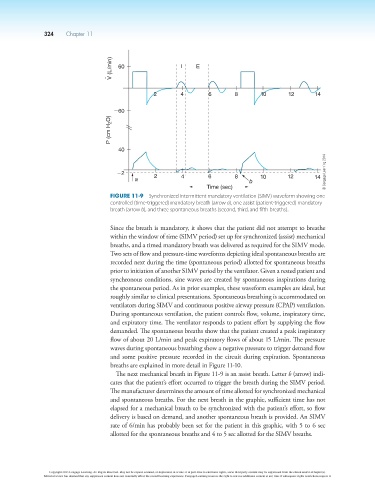
                                            Figure 11-9  Synchronized intermittent mandatory ventilation (SIMV) waveform showing one
                                            controlled (time-triggered) mandatory breath (arrow a), one assist (patient-triggered) mandatory
                                            breath (arrow b), and three spontaneous breaths (second, third, and fifth breaths).


                                            Since the breath is mandatory, it shows that the patient did not attempt to breathe
                                            within the window of time (SIMV period) set up for synchronized (assist) mechanical
                                            breaths, and a timed mandatory breath was delivered as required for the SIMV mode.
                                            Two sets of flow and pressure-time waveforms depicting ideal spontaneous breaths are
                                            recorded next during the time (spontaneous period) allotted for spontaneous breaths
                                            prior to initiation of another SIMV period by the ventilator. Given a rested patient and
                                            synchronous conditions, sine waves are created by spontaneous inspirations during
                                            the spontaneous period. As in prior examples, these waveform examples are ideal, but
                                            roughly similar to clinical presentations. Spontaneous breathing is accommodated on
                                            ventilators during SIMV and continuous positive airway pressure (CPAP) ventilation.
                                            During spontaneous ventilation, the patient controls flow, volume, inspiratory time,
                                            and expiratory time. The ventilator responds to patient effort by supplying the flow
                                            demanded. The spontaneous breaths show that the patient created a peak inspiratory
                                            flow of about 20 L/min and peak expiratory flows of about 15 L/min. The pressure
                                            waves during spontaneous breathing show a negative pressure to trigger demand flow
                                            and some positive pressure recorded in the circuit during expiration. Spontaneous
                                            breaths are explained in more detail in Figure 11-10.
                                             The next mechanical breath in Figure 11-9 is an assist breath. Letter b (arrow) indi-
                                            cates that the patient’s effort occurred to trigger the breath during the SIMV period.
                                            The manufacturer determines the amount of time allotted for synchronized mechanical
                                            and spontaneous breaths. For the next breath in the graphic, sufficient time has not
                                            elapsed for a mechanical breath to be synchronized with the patient’s effort, so flow
                                            delivery is based on demand, and another spontaneous breath is provided. An SIMV
                                            rate of 6/min has probably been set for the patient in this graphic, with 5 to 6 sec
                                            allotted for the spontaneous breaths and 4 to 5 sec allotted for the SIMV breaths.


                        Copyright 2013 Cengage Learning. All Rights Reserved. May not be copied, scanned, or duplicated, in whole or in part. Due to electronic rights, some third party content may be suppressed from the eBook and/or eChapter(s).
                      Editorial review has deemed that any suppressed content does not materially affect the overall learning experience. Cengage Learning reserves the right to remove additional content at any time if subsequent rights restrictions require it.

