


Page 365 - Clinical Application of Mechanical Ventilation
P. 365
Ventilator Waveform Analysis  331


                                                     Time-Limited Ventilation
                                           80
                                         V (L/min)              V  = 0.5 L*    Flow-Limited Ventilation
                                                                 T


                                                          A                        B


                                                        1        2        3       4       5        6        7


                                        P (cm H 2 O)  280


                                           40

                                                                  Increased Volume
                                                                  Increased P ALV
                                                           P ALV                      P ALV
                                          22                                                                        © Cengage Learning 2014
                                                        1        2        3       4       5        6        7
                                                                            Time (sec)
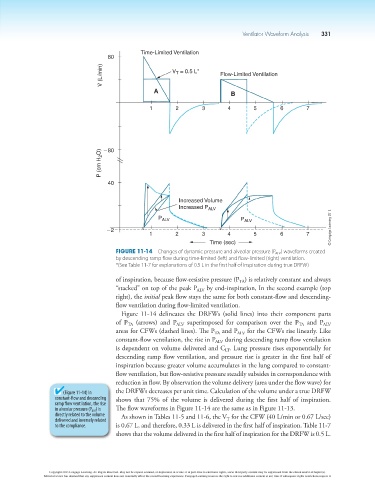
                                             Figure 11-14  Changes of dynamic pressure and alveolar pressure (P ALV ) waveforms created
                                             by descending ramp flow during time-limited (left) and flow-limited (right) ventilation.
                                             *(See Table 11-7 for explanations of 0.5 L in the first half of inspiration during true DRFW)
                                             of inspiration, because flow-resistive pressure (P ) is relatively constant and always
                                                                                      TA
                                             “stacked” on top of the peak P ALV  by end-inspiration, In the second example (top
                                             right), the initial peak flow stays the same for both constant-flow and descending-
                                             flow ventilation during flow-limited ventilation.
                                               Figure  11-14  delineates  the  DRFWs  (solid  lines)  into  their  component  parts
                                             of  P   (arrows)  and  P ALV   superimposed  for  comparison  over  the  P   and  P ALV
                                                 TA
                                                                                                         TA
                                             areas for CFWs (dashed lines). The P  and P ALV  for the CFWs rise linearly. Like
                                                                              TA
                                             constant-flow ventilation, the rise in P ALV  during descending ramp flow ventilation
                                             is dependent on volume delivered and C . Lung pressure rises exponentially for
                                                                                 LT
                                             descending ramp flow ventilation, and pressure rise is greater in the first half of
                                             inspiration because greater volume accumulates in the lung compared to constant-
                                             flow ventilation, but flow-resistive pressure steadily subsides in correspondence with
                                             reduction in flow. By observation the volume delivery (area under the flow wave) for

                            (Figure 11-14) In   the DRFWs decreases per unit time. Calculation of the volume under a true DRFW
                          constant-flow and descending   shows  that  75%  of  the  volume  is  delivered  during  the  first  half  of  inspiration.
                          ramp flow ventilation, the rise
                          in alveolar pressure (P ALV ) is   The flow waveforms in Figure 11-14 are the same as in Figure 11-13.
                          directly related to the volume   As shown in Tables 11-5 and 11-6, the V  for the CFW (40 L/min or 0.67 L/sec)
                          delivered and inversely related                         T
                          to the compliance.  is 0.67 L, and therefore, 0.33 L is delivered in the first half of inspiration. Table 11-7
                                             shows that the volume delivered in the first half of inspiration for the DRFW is 0.5 L.


                        Copyright 2013 Cengage Learning. All Rights Reserved. May not be copied, scanned, or duplicated, in whole or in part. Due to electronic rights, some third party content may be suppressed from the eBook and/or eChapter(s).
                      Editorial review has deemed that any suppressed content does not materially affect the overall learning experience. Cengage Learning reserves the right to remove additional content at any time if subsequent rights restrictions require it.

